
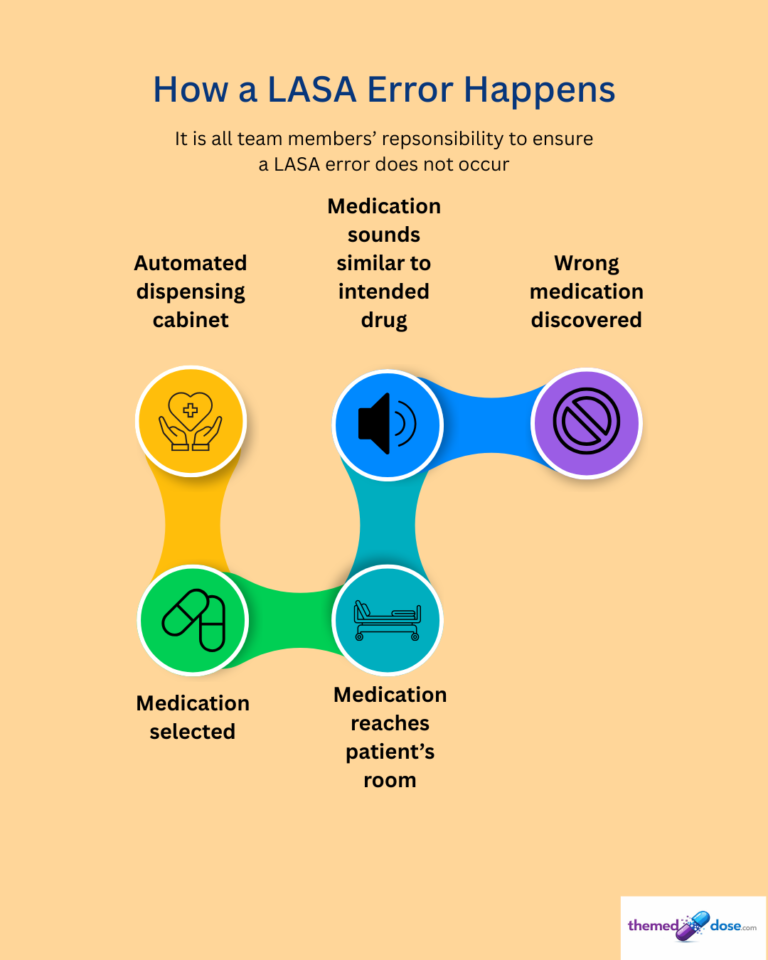
You’ve been a nurse for many years. Pulling out of the automated dispensing cabinet feels like an automatic task for you now. You gather all the medications you pulled out for your patients. Going from room by room, you finish your current med pass. In the last room, however, the medication you pulled will not be accepted by the scan. When you turn the packaging around, you notice it is the wrong medication. It sounds similar to the one you were supposed to pull, and you didn’t notice it was the wrong one until now. This is an example of an error caused by a sound-alike medication.
Introduction
The use of medication is one of the top ways to treat illnesses around the world. Technology has come a long way since the beginning, from barcode scanning to EHR alerts. Many safeguards are placed to avoid medication errors, yet they still happen. One cause of medication errors is drugs that are “look-alike”, “sound-alike”, or they are both (LASA). Medication names matter because they are the main way to communicate what drug someone is talking about. When the communication is misunderstood, however, it could lead to dangerous consequences.
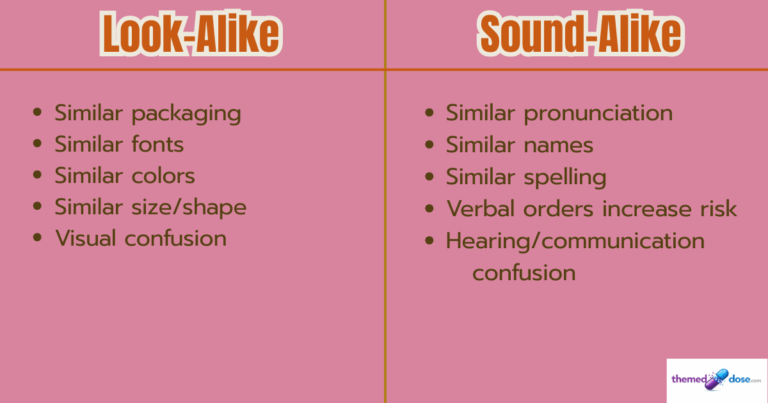
Look-alike medications include drugs that may get confused due to similar fonts, shade, and size (Ryan et al., 2024). Sound-alike medications are drugs that share similar names and might be confused with each other when spoken. Verbal orders, phone calls, and communication in a busy healthcare environment can increase the risk of an error. Errors with LASA medications can easily occur because the other individual will not know that they misunderstood what was communicated. Potential risks include a completely different treatment, adverse events, or non-treatment of a condition.
These errors are not just specific to a hospital. They can happen in all pharmacy environments, clinics, and even at home. For example, a patient may approach a retail pharmacist for a recommendation on a medication for a cold. The pharmacist may state the name and say, “Pick up the blue bottle on the left of the aisle”, not knowing that there is another medication in a blue bottle in the same area. This could potentially lead to the patient purchasing the wrong drug.
Why LASA Errors Occur
From my viewpoint as a pharmacy technician, the most worrisome part of LASA errors is that the person making the error will very likely not know they made an error until it’s too late. Many drugs have similar names, which could cause the other person to truly think that they heard a certain drug’s name. The same can happen when someone is expecting to find a drug that is within a certain package or has a certain color. These mistakes are even more common in a rushed environment.
Written prescriptions often carry the risk of confusion as well. Poor handwriting causes the person reading it to judge what the writer is trying to communicate. Sound-alike drugs commonly have similar ways to spell the medication name, making this judgment call risky. Verbal orders have the same risk. All these factors, combined with interruptions and distractions, make a LASA error likely to occur. The nurse, doctor, or pharmacist could be experiencing fatigue either from the EHR system or the workload, leading to an inability to think as clearly. Read more about alert fatigue here. All the listed causes of error are prone to confirmation bias. Confirmation bias is hearing or seeing what the person wants to hear or see. This makes knowledge of the mistake harder to come by.
The Consequences of LASA Medication Errors
After a LASA medication error occurs, it is important to rectify the mistake quickly, especially if it could cause patient harm. LASA drugs can cause medication errors that lead to compromises of the patients’ safety (Lohmeyer et al., 2023). Some harms and consequences of a LASA medication error include:
- Delayed treatment
- Adverse drug events
- Hospitalization
- Treatment failure
- Toxicity
- Serious patient harm
- Increased healthcare costs
- Loss of patient confidence
The listed consequences vary from emotional to nearly fatal. Although loss of patient confidence may not seem that important, all healthcare workers should understand the level of trust and hope a patient has in the team. Losing this trust is very harmful.
How Pharmacists and Pharmacy Technicians Can Reduce LASA Errors
Pharmacists and pharmacy technicians play an important role in reducing LASA errors. When reviewing physician orders, the pharmacist should carefully verify the medication name, especially if it’s known to be a high-alert LASA drug. The pharmacist should also compare the drug name and dosage to the patient’s indication when appropriate. For example, if the patient has high blood pressure, but the pharmacist heard a drug for an antibiotic, that should raise a flag.
A pharmacist should also read or verbally take down an incoming order with a clear mind and be careful not to assume based on familiarity. Tall Man Lettering is helpful to decipher sound-alike drugs. Tall Man Lettering is a method where unique written parts of the drug name are capitalized on medication labels. A study conducted by Lohmeyer et al. shows that the use of Tall Man Lettering reduces the error rate of critical care nurses when looking at syringes (Lohmeyer et al., 2023). A good step to take in the pharmacy, which I have also noticed in my practice as a technician, is to separate commonly confused medications on physical shelves or in the automated dispensing cabinet drawers. Pharmacists should perform independent double checks when reviewing and filling medication, and pharmacy technicians should perform double checks when filling or loading. Minimizing interruptions is very helpful to avoid a clear LASA mix-up. All staff should report near misses when they occur to allow for improvement and feedback on the current processes by the pharmacy.
Technology: Helpful, but not Perfect
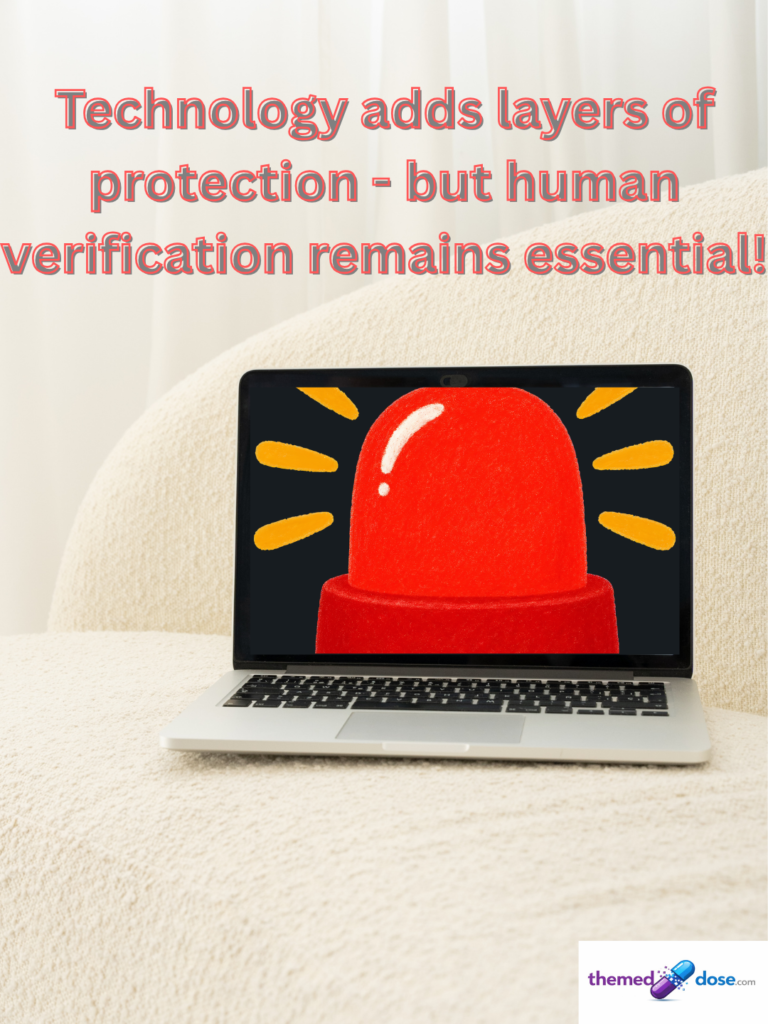
Methods such as barcode medication administration and computerized provider order entry are useful tools, but they cannot replace human verification. Not only is the barcode of the medication used during administration, but also during loading in the automated dispensing cabinet, allowing for two checks; however, it is not perfect. For example, a nurse can work around the alert, or, especially in times of emergency, some drugs are not scanned at all. Computerized order entry helps to avoid some “sound-alike” errors, but this is not perfect if the spelling gets confused, regardless of the digital entry. In previous blog posts, we have discussed how useful clinical decision support systems (CDSSs) are in patient care, but have also noted some of their imperfections. Read more about the EHR system here. Pharmacy dispensing software and automated dispensing cabinets both allow for alerts to pop up if the medication is not appropriate or a match; however, these alerts can be worked around or ignored. Automated dispensing cabinets improve the safety for patients by facilitating medication consumption; however, 70% of the cabinet’s products were associated with LASA risk, making nurse oversight vital (Ruutiainen et al., 2021). Overall, technology is helpful, but the healthcare team should not rely on it alone. The pharmacist should always use their clinical judgement on top of the help of the technology. Prescribers, nurses, and other healthcare professionals are other members of the healthcare team who could perform additional layers of verification. Read more about technology in pharmacy here.
Conclusion
Look-alike and sound-alike medications remain an important medication safety concern because an error can occur before anyone realizes that a mistake has been made. Similar names, packaging, interruptions, fatigue, and assumptions can all contribute to a LASA error, potentially resulting in delayed treatment, adverse drug events, treatment failure, or serious patient harm.
Technology has provided healthcare professionals with valuable tools to help prevent these errors, including barcode scanning, computerized order entry, dispensing software, and clinical decision support systems. However, these systems are not perfect and should not replace careful human verification. Pharmacists, pharmacy technicians, nurses, prescribers, and other healthcare professionals each play an important role in creating multiple layers of protection for patients.
Preventing LASA errors requires more than simply recognizing which medications are easily confused. Ultimately, medication safety depends on combining technology with clinical judgment, effective communication, and a culture in which every member of the healthcare team takes an active role in preventing harm.
References
Lohmeyer, Q., Schiess, C., Wendel Garcia, P. D., Petry, H., Strauch, E., Dietsche, A., Schuepbach, R. A., Buehler, P. K., & Hofmaenner, D. A. (2023). Effects of tall man lettering on the visual behaviour of critical care nurses while identifying syringe drug labels: a randomised in situ simulation. BMJ Qual Saf, 32(1), 26-33. https://doi.org/10.1136/bmjqs-2021-014438
Ruutiainen, H. K., Kallio, M. M., & Kuitunen, S. K. (2021). Identification and safe storage of look-alike, sound-alike medicines in automated dispensing cabinets. Eur J Hosp Pharm, 28(Suppl 2), e151-e156. https://doi.org/10.1136/ejhpharm-2020-002531
Ryan, A. N., Robertson, K. L., & Glass, B. D. (2024). Look-alike medications in the perioperative setting: scoping review of medication incidents and risk reduction interventions. Int J Clin Pharm, 46(1), 26-39. https://doi.org/10.1007/s11096-023-01629-2
Author Bio
I am a healthcare professional and pharmacy technician with experience in pharmacy practice and medication-related topics. I am passionate about medication safety, healthcare education, and making complex healthcare information easily accessible. Through TheMedDose, I share practical insights on medications, pharmacy practice, and patient safety to help the public better understand the impact of medications in everyday care.
Pingback: When a Medication Error Doesn’t REach the Patient – the Importance of Near-Misses – themeddose