
You’re ten hours into a twelve-hour hospital shift. The healthcare team relies on you to verify medication orders and protect patients from medication errors. Alert after alert appears on your screen. At first, you carefully reviewed every warning. Now, after hundreds of alerts, you find yourself clicking through them almost automatically. What you are experiencing is alert fatigue.
Introduction
Alert fatigue occurs in hospitals and pharmacies more often than you’d think. Clinical decision support systems (CDSSs) have their benefits, but too many alerts in a given time could lead to physicians, pharmacists, and others on the healthcare team to start ignoring or overriding the alerts (Dahmke et al., 2023). Clinical decision support systems were designed to improve medication safety by generating alerts for potential problems, such as to warn the healthcare team about drug interactions, duplicate therapies, allergies, high/low doses, renal dosing, hepatic dosing, pregnancy warnings, and age-specific warnings. The goal of these alerts is to prevent medication errors, but it may be too much of a good thing at times. Read more about EHR here.
Many alerts are expected, clinically insignificant, duplicate, too sensitive, or generated automatically. When a pharmacist repeatedly encounters alerts that are clinically appropriate to override, responding to them can gradually become automatic without realizing it. In hospitals, a pharmacist could receive dozens, or even hundreds, of alerts during their shift, and many that don’t require a change in therapy. This has the potential to lead to an autopilot method of not paying attention to the alert.
Alert Fatigue in Hospital Pharmacies
The above example is taking place in a hospital pharmacy. From my experience as a pharmacy technician, alert discussions seemed to occur more frequently in the hospital setting than in retail or specialty pharmacies. This is likely due to the large number of medication orders that hospital pharmacists review throughout the day, many of which change as patients’ conditions evolve. When the pharmacist must verify an order, they must review the IV antibiotics given, critical care medications, chemotherapy, anticoagulants, insulin, and pain medication. Although many patients come through the hospital and don’t receive any of the mentioned examples, the pharmacist must still ensure to review the list of orders.
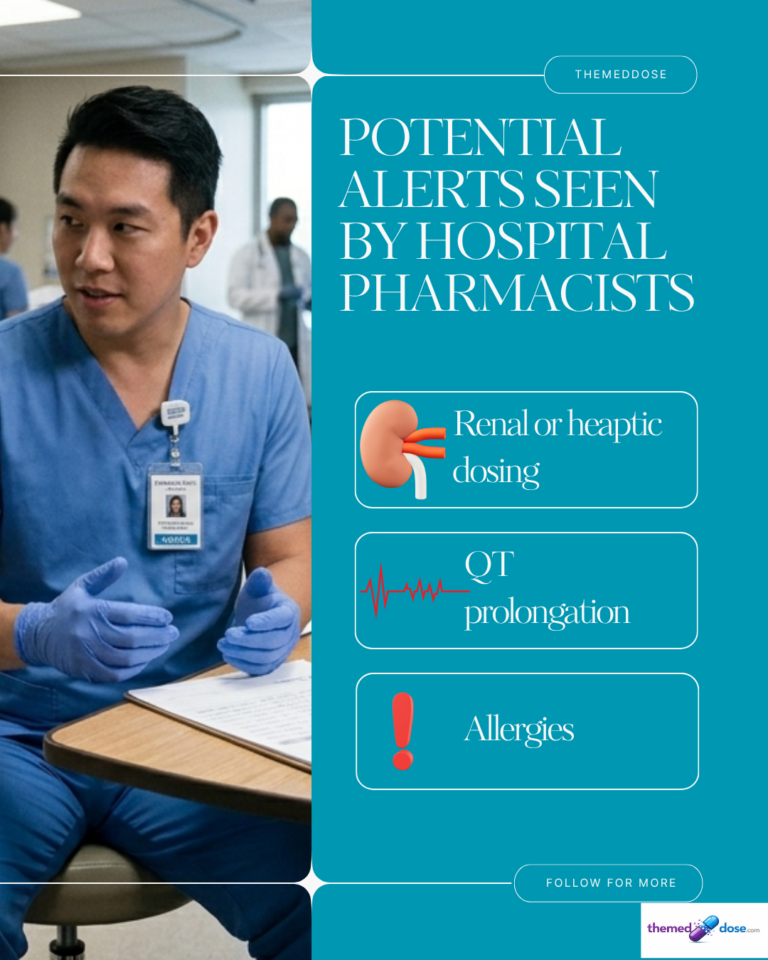
Potential alerts that hospital pharmacists may encounter are:
- Renal or hepatic dosing
- QT prolongation
- Duplicate anticoagulants
- Drug Interactions
- Allergies
Taking these alerts into consideration and reviewing ongoing orders is already a heavy workload. When combined with emergencies, high patient volumes, multiple providers, and frequent order changes, it could be understandable why alert fatigue is so common.
Alert Fatigue in Retail Pharmacies
While it is tempting to think that retail pharmacies face much less pressure than hospital pharmacies, it is important to recognize that they carry their own risks of alert fatigue. Retail pharmacists receive different kinds of alerts, but these alerts still come up just as often as in the hospital pharmacy. Common alerts in the retail pharmacy include:
- Early refill requests
- Drug interactions
- Drug therapies
- Incorrect quantities
- Insurance formulary issues
- Allergy alerts
- Age warnings
In addition to these warnings, retail pharmacists must also manage vaccinations, counsel patients, handle phone calls, take care of insurance problems, and get through long prescription queues.
Ignoring Every Alert is Not the Answer
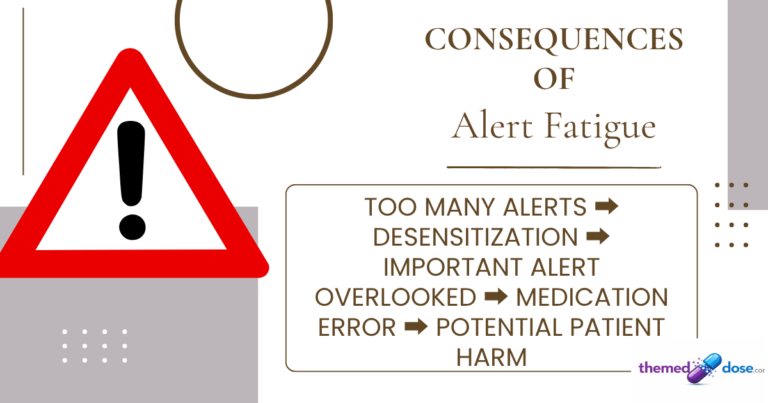
High override rates are partly caused by the number of clinical alerts (Choukroun et al., 2022). It is tempting to ignore incoming notifications during alert fatigue; however, ignoring them is not the answer. When the systems cause fatigue, they may increase the likelihood of errors (Alshehri & Alanazi, 2023). Pharmacists must still evaluate if the flagged interaction is clinically meaningful, if the patient is already tolerating the medications, if the benefits outweigh the risks, if mentoring is sufficient, and if the prescriber already knows about the interaction.
It is up to the pharmacist to decipher between appropriate and inappropriate overrides. As fatigue increases, important alerts might start to get mixed in with insignificant ones. As more unsubstantial notifications come in, the pharmacist is likely to become desensitized to the warning, leading to potential medication errors. Read more about medication interactions here.
Factors that Contribute to Alert Fatigue
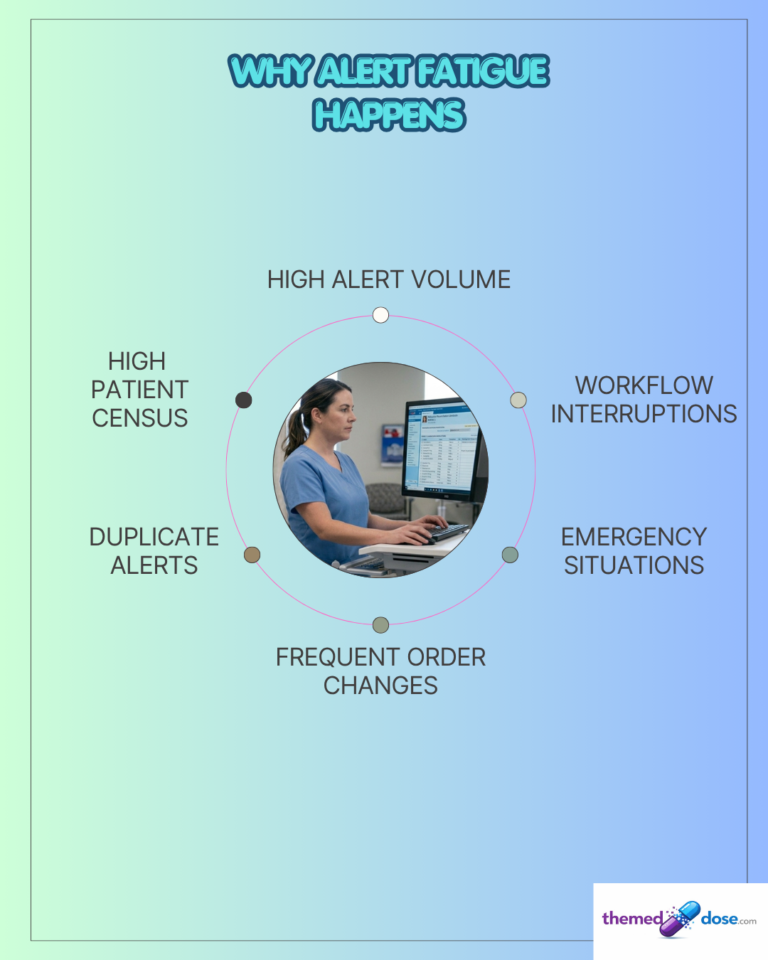
Understanding the factors that contribute to alert fatigue is helpful because pharmacists can keep an eye out for the signs of alert fatigue. High alert volumes are one of the biggest causes of alert fatigue. A pharmacist could receive hundreds of alerts per shift. Many of these alerts may be safe to override, but having to triage the alert could be exhausting for the pharmacy staff. Frequent orders continue to come in and may require modifications by the pharmacist, leading to an increased mental load and workload. Many hospitals have spikes in the patient census, causing a sudden and unexpected workload for the pharmacy staff.
In addition to the alert volumes, pharmacists must also deal with workflow interruptions. Emergencies can arise at any time, bringing the pharmacist’s attention away from the current queue. Phone calls and provider questions are ongoing throughout the shift, which the pharmacist has to answer in a timely manner. They must also factor in medication orders and STAT orders. Overall, the pharmacist must manage a lot during their shift, putting an extra burden on alert fatigue.
Strategies to Reduce Alert Fatigue
Utilizing strategies to reduce alert fatigue is the next step after becoming aware of alert fatigue. The first method is to improve alert specificity by removing unnecessary alerts and reducing duplicate notifications. Another method that could be utilized is to prioritize the high-risk alerts by using categories such as “informational vs. moderate vs. clinical”. This allows the pharmacist to put their energy into the alerts that have an impact. In the long run, it would be helpful to optimize the CDSSs to allow for regular review of alert rules, update the outdated thresholds, and tailor the filters for the institution. Incorrect configuration of the CDSSs can disrupt daily operations, so upgrading the system can resolve a lot of obstacles (Choukroun et al., 2022). Over time, incorporating feedback from pharmacists would be of great benefit. As healthcare technology continues to evolve, optimizing alert systems will remain an essential component of improving medication safety while reducing unnecessary cognitive burden on pharmacists.
Conclusion
Alert fatigue has become an increasingly recognized challenge in healthcare, affecting pharmacists who rely on clinical decision support systems to promote patient safety. Although these systems were designed to prevent medication errors and improve clinical decision-making, an overwhelming number of low-value or repetitive alerts can reduce their effectiveness by causing healthcare professionals to become desensitized to important warnings.
Regardless of the type of pharmacy, pharmacists must balance a high volume of medication orders, constant workflow interruptions, and complex clinical decisions while carefully evaluating each alert. The goal should not be to eliminate clinical decision support systems but to ensure they provide meaningful, relevant, and actionable notifications. Improving alert specificity, reducing unnecessary interruptions, and continuously refining alert systems can help lessen cognitive burden while allowing clinicians to focus on the warnings that truly matter.
Ultimately, patient safety depends not only on having safety alerts in place but also on designing systems that healthcare professionals can trust and use effectively. By recognizing alert fatigue and implementing strategies to reduce it, healthcare organizations can create safer workflows, support clinician well-being, and improve the quality of patient care.
References
Alshehri, N., & Alanazi, A. (2023). Pharmacists’ Perceptions on Safety Alerts of the Drug Utilization Review (DUR) in Electronic Health Records in a Tertiary Healthcare Hospital. Pharmacy (Basel), 11(4). https://doi.org/10.3390/pharmacy11040119
Choukroun, J. F., Lee, K., & Rey, A. (2022). Creating Meaningful Alerts and Reducing Alert Fatigue: Strategies Implemented by Informatics Pharmacists to Optimize Dose Range Checking Alerts in a Multihospital Health System. J Pharm Technol, 38(6), 319-325. https://doi.org/10.1177/87551225221117152
Dahmke, H., Fiumefreddo, R., Schuetz, P., De Iaco, R., & Zaugg, C. (2023). Tackling alert fatigue with a semi-automated clinical decision support system: quantitative evaluation and end-user survey. Swiss Med Wkly, 153, 40082. https://doi.org/10.57187/smw.2023.40082
Author Bio
I am a healthcare professional and pharmacy technician with experience in pharmacy practice and medication-related topics. I am passionate about medication safety, healthcare education, and making complex healthcare information easily accessible. Through TheMedDose, I share practical insights on medications, pharmacy practice, and patient safety to help the public better understand the impact of medications in everyday care.
Pingback: When Similar Names and looks Become Dangerous: Preventing LASA Medication Errors – themeddose
Pingback: AI and Medication Safety: What Happens When We Trust AI With Our Health? – themeddose