
You feel like you are all set for your procedure the next day. You have the bag packed, insurance card, ID, and, of course, the medication list the nurse on the phone asked you to bring. The next day seems to be going smoothly, except there is some confusion caused by discrepancies between your medication list and what the hospital system has. This is when you realize how important the list that you created is.
Introduction
Creating your own medication list may appear to be a simple task until you find a hospital, doctor’s office, or pharmacy document that conflicts with the one you have. Although this may not seem like a big deal, it is very important for your healthcare team, including the pharmacy team, to know exactly what you are taking. Even a small mistake on any of the lists could lead to incorrect doses, missed doses, wrong frequency, or dangerous interactions. The healthcare industry continuously implements safety measures to reduce medication-related errors, and my experience as a pharmacy technician has shown me that medication reconciliation remains one of the most important opportunities to improve patient safety. This blog post focuses on the defining aspects of medication reconciliation (MedRec), why it matters, when MedRec should be performed, common errors when performing it, and technology’s role.
What is Medication Reconciliation (MedRec), and when should it be performed?
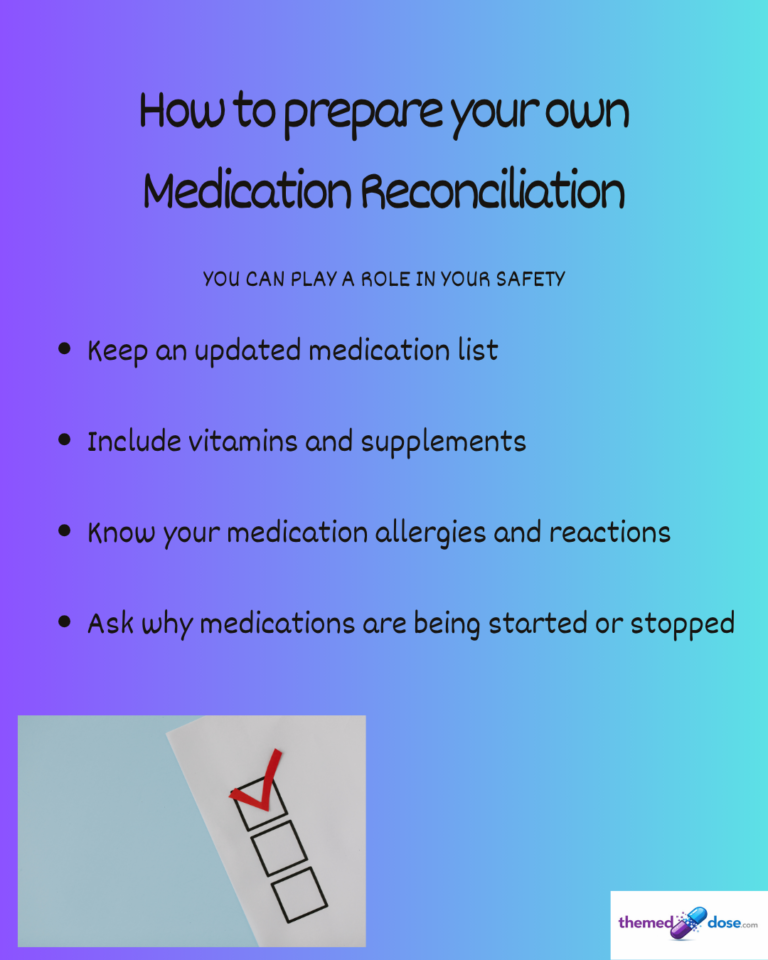
According to Ciudad-Gutierrez et al., MedRec is a “recognized strategy to improve patient safety during transition of care” (Ciudad-Gutierrez et al., 2023). The main goal of MedRec is to create the most accurate medication list possible for the patient, providers, and pharmacists to ensure safety. This list should include everything taken by the patient, including vitamins, supplements, and over-the-counter items. This will help the doctor determine the most useful medication for the patient, and the pharmacist can review for possible interactions, etc. It starts with obtaining the best possible medication history (BPMH) through two sources and comparing it with the patient’s list (Powis et al., 2023).
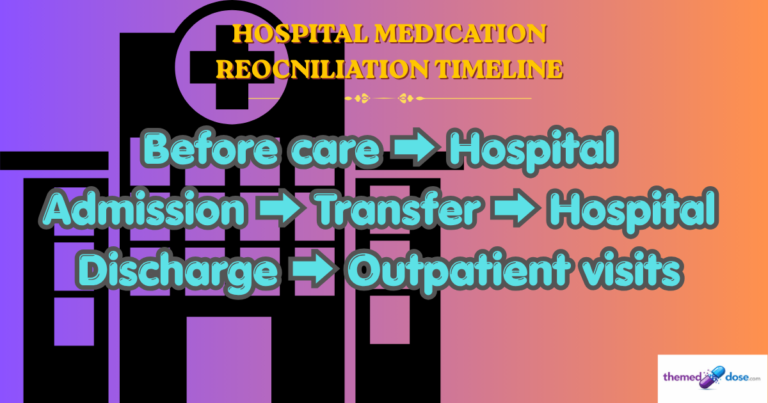
There are multiple points where MedRec is useful. The most common time for MedRec to be performed is at hospital admission. MedRec could be performed by a hospital pharmacist or a trained pharmacy technician. Many patients may not be coming from or returning to home; therefore, making transfers another common time to perform MedRec. Examples of this include nursing homes, rehabilitation centers, or long-term care facilities. Upon arrival, the healthcare team needs an accurate medication history to determine which medications should be continued, adjusted, temporarily held, or discontinued based on the patient’s current condition.
From my personal experience as a patient and pharmacy technician, discharge is one of the most vulnerable points in the medication reconciliation process. Discharge from the hospital can be an overwhelming time, especially when various instructions are being given at once, for example, a diet to follow, wound dressing changes, and medications. It is very important to note to the patient and transfer facility, if applicable, any medications that should be continued or stopped and if new prescriptions were sent to the pharmacy. One of the most common questions I receive while ringing up customers at the pharmacy is “Why did my doctor send this medication?” following discharge from a hospital. This shows that the MedRec and the new list were not properly explained to the patient. Lastly, MedRec should be done at outpatient visits. This should not be exclusive to specialists and should include primary care providers, as the primary care physician is typically the doctor who follows the patient throughout any care.
Common Medication Reconciliation Errors
A very common error when performing MedRec is the omission of medications. This is not done maliciously by the patient, so it is important for the personnel performing the MedRec to specifically ask whether any non-prescription items were taken, such as vitamins, supplements, or OTC medications. One important note about missing medications is that the healthcare provider or pharmacist will not be aware of the medication at all, potentially leading to an increased risk of interactions or decreased efficiency of the drug.
Another common mistake is an incorrect dose being stated. An example would be if a patient is used to taking 5mg of one drug but is just told to take 10mg instead the day before admission; they might accidentally state 5mg. If the patient receives the wrong dose during the hospital stay, it could potentially lead to the patient not getting adequate treatment for their other condition. Following this same note is frequency; a patient may get too little or too much of a medication if not stated correctly by the patient or properly researched by the pharmacy team.
The next common MedRec error is duplicate medications. If the pharmacy team uses the list stated by the patient and the list that could be pulled from the pharmacy, they must ensure that the list is being appropriately reviewed to remove any duplications. Duplications can be either the same exact drug, dose, and frequency listed twice, a combination of the same drug but different dose or frequency, or a different drug that is like a drug on the list.
Incorrect allergy documentation during MedRec can cause obstacles to appropriate care. A missed allergy documentation puts the patient at a higher risk of a reaction, whereas documenting something as an allergy that is not truly considered one could cause the patient to not receive the treatment that would help them the most.
Lastly, during MedRec, the pharmacist or provider may find that a medication should have been discontinued some time back, but the patient remained on it. Continuing a medication that should have been discontinued may alter the care of, and maybe even, the health status of the patient. For example, some women after delivering a baby may have to take blood pressure medication for a spike after birth, but this medication is commonly discontinued after the blood pressure comes back to normal. If the patient is not aware of this, she could put herself at risk for a dangerous dip in blood pressure.
Barriers exist with medication reconciliation, making the potential errors more difficult. These include lack of physical and financial resources, high patient volumes, and difficulty obtaining information from external systems (Powis et al., 2023). Yamada et al. (2024) found that medication history-taking accounted for a substantial proportion of medication discrepancies identified during reconciliation, highlighting the importance of obtaining an accurate medication history. With this high rate of errors, it is important to reduce barriers and be aware of potential mistakes
Technology’s Role in MedRec
Fortunately, technology can help guide staff to an accurate MedRec. The electronic health record, or EHR, is a common place physicians and pharmacists look for the most recent medication list. This may not be the most accurate, however, because they might include an outdated list if the patient hasn’t visited the hospital in a long time. Additionally, some EHR systems may not connect to another hospital system, leading to conflicting information. Patient portals are commonly linked to the EHR, allowing the patient to correct any mistakes if necessary or provide updated information if needed. If EHR systems are not connected, the patient could bring up the portal to show the physician or the personnel performing the MedRec.
Pharmacy databases will include what the patient was prescribed, the date it was prescribed, and if/when the patient picked up the medication. This could be helpful information for the MedRec pharmacist, as some patients know they should be taking a medication, but may not have picked it up from the pharmacy yet.
Although the recent technology helps, the patient should remain informed to allow them to be the best source of this list, as well as an advocate. Additionally, while there are many tools to help overall health, electronic tools for MedRec specifically are slim. Information technology continues to be useful, however, because it optimizes workflow and has a greater ability to ensure safety through reviewing pharmacotherapeutic information and checking for discrepancies (Ciudad-Gutierrez et al., 2023).
Conclusion
Creating an accurate MedRec is important to the patient, providers, and pharmacists. This ensures the safety of the patient both in and out of the hospital. Having the BMHP allows for informed decisions by the staff and can improve the patient’s care. Although many tools exist for MedRec, the importance of speaking to the patient and continuing education on medication is still very high. Whenever you bring your medication list to a procedure or doctor’s office, always remember it is more than a piece of paper; it is the safety of your care.
References
Ciudad-Gutierrez, P., Del Valle-Moreno, P., Lora-Escobar, S. J., Guisado-Gil, A. B., & Alfaro-Lara, E. R. (2023). Electronic Medication Reconciliation Tools Aimed at Healthcare Professionals to Support Medication Reconciliation: a Systematic Review. J Med Syst, 48(1), 2. https://doi.org/10.1007/s10916-023-02008-0
Powis, M., Dara, C., Macedo, A., Hack, S., Ma, L., Mak, E., Morley, L., Kukreti, V., Dave, H., Kirkby, R., & Krzyzanowska, M. K. (2023). Implementation of medication reconciliation in outpatient cancer care. BMJ Open Qual, 12(2). https://doi.org/10.1136/bmjoq-2022-002211
Pingback: Electronic Health Records and Medication Safety: How Technology Protects Patients – themeddose
Pingback: AI and Medication Safety: What Happens When We Trust AI With Our Health? – themeddose
Pingback: Can You Safely Restart an Old Prescription? What to Know Before Taking That Medication Again - themeddose