
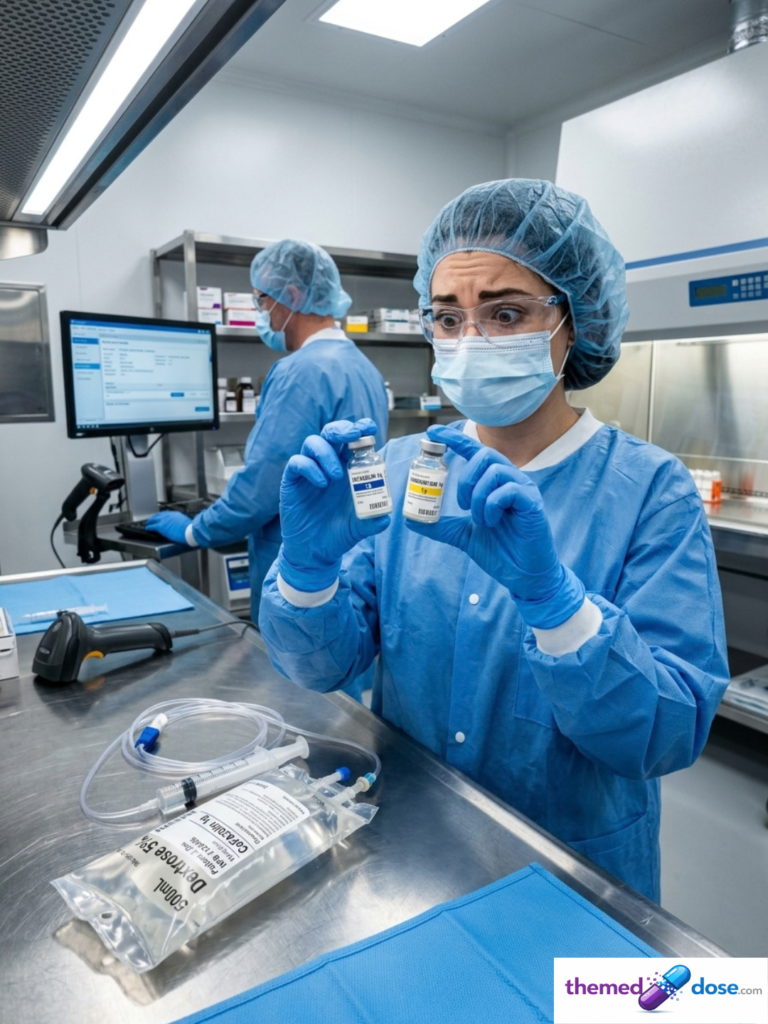
You’re becoming cross-eyed. You are usually good at keeping a good energy level at work, but you’re finding it hard to concentrate during this shift. You’re about to send out an IV you made in the IV room to the pharmacist but suddenly notice you have the wrong drug vial in your hand. Although you’re exhausted, you are very thankful to catch this mistake before it gets to the patient.
Introduction
Here’s the question many health professionals involved in medication administration have at some point: “If the patient was never harmed, why does the near-miss event matter?”, but a near-miss still counts as an event that should be documented. Near-misses should be documented and investigated, regardless of the result. They can reveal weaknesses in the medication-use process, allowing healthcare professionals and organizations to identify risks before they result in patient harm. As a former inpatient pharmacy technician, I can see how the documentation of a near-miss can be helpful. For example, if a near-miss was caused by two vials of different drugs looking identical, a flag can be put on their bins to alert technicians and pharmacists that the vial looks like another one in the pharmacy.
What is a Medication Near-Miss?
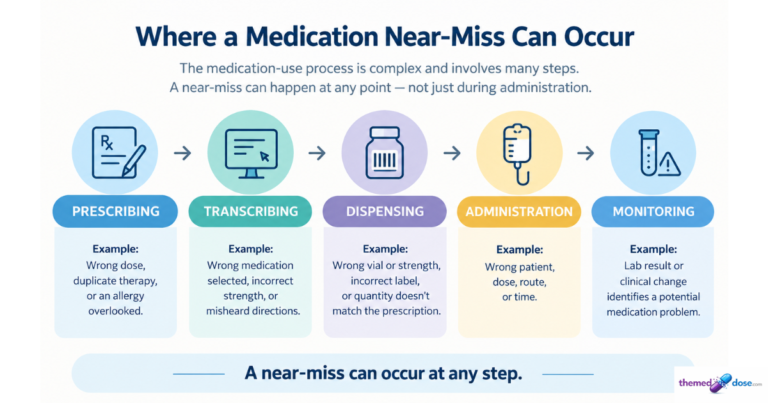
Before we define a near-miss, it is important to understand the definition of a medication error. A medication error is a preventable event that may lead to inappropriate medication use or patient harm. A near-miss, however, is an error or unsafe situation that is detected and corrected before reaching the patient. It can occur during prescribing, transcribing, dispensing, administration, and monitoring. Each healthcare professional involved in the medication-use process has a role in identifying and preventing potential errors.
Where a Near-Miss can Occur
The process of drug administration is complex and involves many steps (Braiki et al., 2024). Medication safety should be the top priority of all steps involved in medication administration, not just the administration step itself. During prescribing, it is important to ensure that the correct dosage and frequency are written or spoken. Additionally, it’s important to check for duplicate therapy, as this could change how the body reacts to the medication given. A prescription can be accidentally written despite a documented allergy or contraindication. It is important to note, however, that a medication may still be appropriate depending on the allergy stated if the benefits outweigh the risks.
During transcribing and data entry, a team member may mistakenly select the wrong medication from the list, especially if it is a LASA drug. Read more about LASA drugs here. Incorrect strength or directions could be mistakenly heard or written down. The person transcribing the prescription should reach out to the ordering physician if there is any confusion.
Technology helps significantly during the dispensing phase due to safeguards in place, such as barcode scanning; however, there are risks for a near-miss to occur in this phase. Infusion programming is an example of how nurses can use IV pumps as a potential safeguard, which can be used for medications such as heparin, insulin, sedatives, opiates, and critical short half-life medications (Waterson et al., 2020). A wrong medication or strength could be selected. Although barcode scanning occurs throughout the filling and administration of a drug, these alerts can be bypassed. Additionally, the system is not aware of other factors of the patients’ condition.
With dispensing, a wrong medication or strength can be mistakenly selected from the shelf or made in the IV room. An incorrect label can be placed on the medication, and the quantity or directions may not match the prescription. During administration, the wrong medication, patient, dose, route, or time can happen if the nurse, or anyone prior in the process, isn’t careful. The error, or near-miss, can be caught before, after, or during administration at the bedside. Lastly, a near-miss can occur during monitoring. A laboratory result or clinical change can identify a potential medication problem before harm occurs.
A Near-Miss is More Than “Someone Caught an Error”
A near-miss is important to document, as it can reveal many things. My example of the identical vials earlier mentions an example of how confusing medication names or packaging can lead to a near-miss. Incomplete or outdated medication information can also lead to a potential mistake in administration. Any member of the team can experience an interruption in workflow, leading to a potential miss. Unclear communication is especially harmful, as the person receiving the information is likely to be unaware that there is misinformation.
Inadequate staffing or time pressure could be very dangerous for the patients, as it could cause the team members to avoid looking over the order for potential errors. Clinical judgment may be minimized during this time. Technology is helpful, but is not perfect, and should not be fully relied on for data entry, fulfillment, or administration. Read more about technology in pharmacy here. As understaffing is apparent, some hospitals, pharmacies, and outpatient care centers have resorted to using memory or individual vigilance; however, this could lead to a potential increase in near misses.
Why Reporting Near-Misses Matters
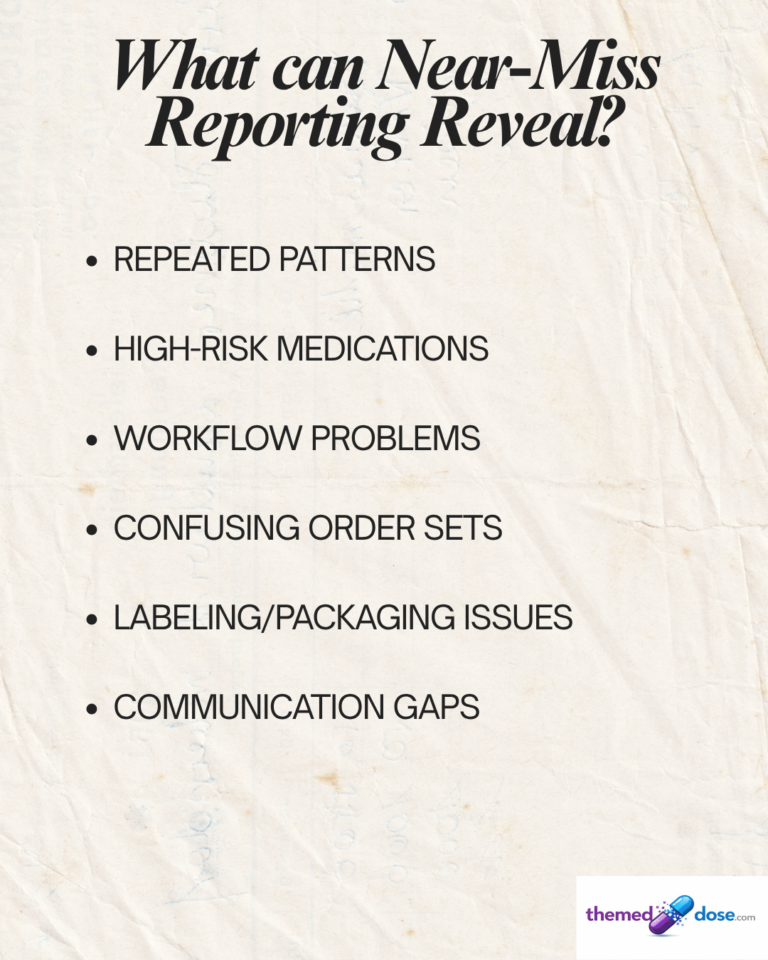
Medication errors occur throughout the world and can affect the health system and the patient (Braiki et al., 2024). Many organizations use near-miss information to improve safety. In my example of two vials looking identical, the pharmacy can learn to flag both drugs as vial look-alikes. Additionally, reporting can help identify:
- Repeated patterns
- High-risk medications
- Problematic workflow steps
- Confusing electronic order sets
- Labeling or packaging concerns
- Communication gaps between healthcare professionals
Organizations can use this information to improve processes. One way they can use information from near-misses is to update procedures to ensure the potential to make an error has decreased. They can also improve staff education and highlight certain drugs. This information can be used to improve or modify technology or alerts. Pharmacies can change the storage location or labeling practices to ensure proper measures are in place to avoid mix-ups or medication errors. Each member of the team should perform their own verification steps in addition to the prior methods, as everyone involved is responsible for the safety of the patient. Overall, the goal should be to improve communication between departments with the goal of patient safety in mind.
Why a Culture of Safety Matters
There is a major difference between learning from errors and near-misses and simply assigning blame. There is no lesson learned when pointing fingers, and, therefore, proper investigation and training should occur after a near-miss. Staff may be less likely to report a near-miss if they fear punishment. Management should encourage the reporting of near-misses and should ensure that there are no negative consequences to reporting one (if appropriate). A safety-focused environment encourages reporting and examination of contributing factors.
Although there should be no unnecessary retaliation against someone reporting an error or near-miss, reporting does not mean every error is harmless or that accountability is unnecessary. The goal of reporting is to understand the circumstances and reduce the chance of recurrence. A culture of safety should support learning while still addressing reckless behavior, intentional violations, or repeated failures to follow established safeguards when appropriate.
The Role of Technology is Helpful, but not Infallible
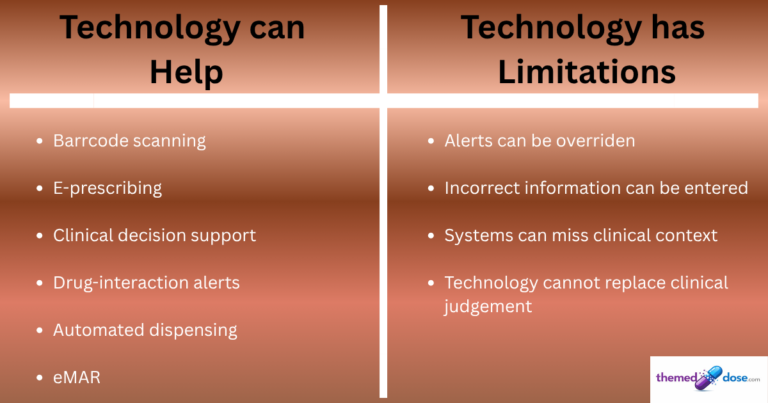
Technology is definitely a good tool to use for medication prescribing, fulfillment, and administration; however, it should not replace clinical judgment. Technology can help identify near-misses through:
- Barcode scanning
- Electronic prescribing
- Clinical decision support
- Drug-interaction alerts
- Automated dispensing systems
- Electronic medication administration records
Conclusion
An important part of recognizing a near-miss is not only catching it but reporting and learning from it. An error can occur for a variety of reasons, including fatigue, distractions, and look-alike drugs. A near-miss should not be interpreted as “nothing happened”, rather, it should be interpreted as a serious event that the team can learn from. It represents an opportunity to identify where the medication-use process could fail before a patient is harmed. Reporting can be useful to an organization, as it can examine workflow, staffing, technology, labeling, storage, communication, and other contributing factors. The workplace should encourage healthcare professionals to report near-misses according to their organization’s procedures. Each report can lead to a bigger impact for the whole team. The goal should not be to never make a mistake; the goal should be for the company to make errors less likely, catch them early, and learn from them when they occur.
References
Braiki, R., Douville, F., & Gagnon, M. P. (2024). Factors influencing the reporting of medication errors and near misses among nurses: A systematic mixed methods review. Int J Nurs Pract, 30(6), e13299. https://doi.org/10.1111/ijn.13299
Waterson, J., Al-Jaber, R., Kassab, T., & Al-Jazairi, A. S. (2020). Twelve-Month Review of Infusion Pump Near-Miss Medication and Dose Selection Errors and User-Initiated “Good Save” Corrections: Retrospective Study. JMIR Hum Factors, 7(3), e20364. https://doi.org/10.2196/20364
Author Bio
I am a healthcare professional and pharmacy technician with experience in pharmacy practice and medication-related topics. I am passionate about medication safety, healthcare education, and making complex healthcare information easily accessible. Through TheMedDose, I share practical insights on medications, pharmacy practice, and patient safety to help the public better understand the impact of medications in everyday care.