
You are holding the tablet nicknamed “the horse pill” in your hand – a large potassium pill. You are normally okay with swallowing drugs, but this one looks significantly larger than what you are used to. You are tempted to put the pill back in the bottle and not take it, in fear that you will choke. You have considered either crushing or splitting it to make it easier…but you are unsure whether that is safe to do.
Introduction
Pills come in various forms, shapes, and sizes. While many people take their medication with ease, some larger pills may be harder for certain populations, such as geriatric and pediatric populations. It’s possible that the full dose is not needed for the patient. It is important not to assume that every tablet is crushable or able to be split, or that every capsule can be safely taken apart, however.
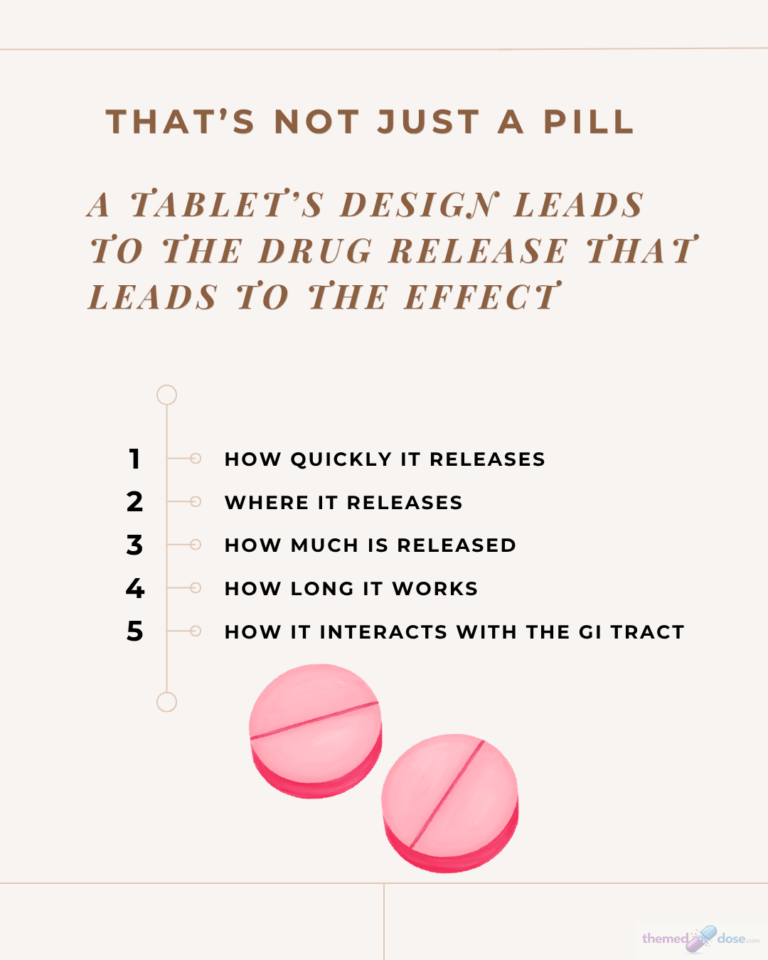
A tablet isn’t necessarily just a container holding medication. A substantial amount of research goes into the drug regarding its design. Its physical design can control how, where, and how quickly the medication is released. The pill’s design is to ensure that the pharmacokinetics and pharmacodynamics are optimal for the patient’s body.
Physicians may have various reasons for instructing the patient to split the pill. One advantage is that the cost of a higher dose may be the same or similar to a lower dose, making splitting a cost-effective alternative. It is also beneficial in situations of titration and provides ease of taking the pill for the geriatric and pediatric populations 1.
A Tablet is More Than its Active Ingredient
Medications can be formulated in different ways to control:
- How quickly the drug is released
- Where it is released
- How much drug becomes available at a particular time
- How the medication interacts with the stomach
- How long the medication works
Read more about medication timing here.
The same medication ingredient can behave very differently depending on how the dosage form is designed. For example, some medications are “enteric coated” to protect the stomach lining from irritation. This delays the release until it is further down, whereas some forms act quickly.
What Happens When you Crush a Tablet?
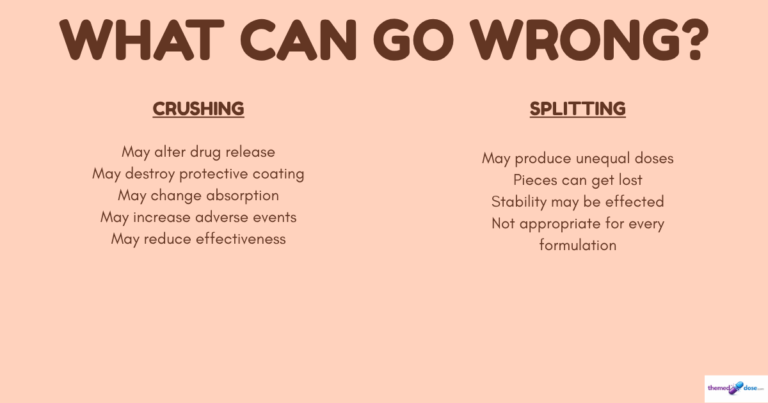
More than the physical appearance of the drug is likely to change when the drug is crushed. Crushing a tablet changes its physical structure and can alter how the medication dissolves and is released. For some formulations, this can cause the drug to be released faster than intended. For some modified-release formulations, crushing can cause the medication to be released more rapidly than intended, potentially increasing adverse effects or altering the drug’s therapeutic effect. When the absorption cannot be properly predicted, patients are at an increased risk from quick absorption or reduced total bioavailability 2. Additionally, any protective outer coating, whether it is to protect the part of the body from the drug or the drug from certain parts of the body, can be destroyed.
Improperly crushing a medication can alter how the drug is released and absorbed. Depending on the medication and formulation, this may affect its therapeutic effect or increase the risk of adverse effects. Many times, medication is crushed into food, and the food item may lead to a different reaction of the drug in the body3. The FDA labeling guidance specifically recognizes that crushing, splitting, or chewing some modified-release products can compromise their release characteristics, effectiveness, or safety4.
What happens when you split a Tablet?
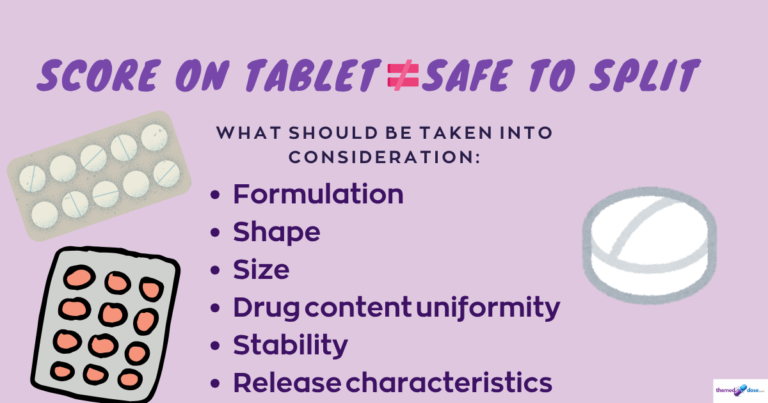
It may be tempting to assume that the presence of score lines means that the tablet is safe to split; however, not all tablets with a score are safe to split into pieces. Tablet size and shape should also be taken into consideration, as smaller pills may be more susceptible to uneven breaks and, if the shape is not symmetrical, that could also lead to uneven doses. If there is any confusion about whether a pill can be split, the patient’s healthcare provider can check whether the tablet has been evaluated for splitting.
There are numerous concerns when splitting a tablet. Tablet splitting can introduce several sources of variability. The two halves may not contain the same amount of drug, and pieces can be lost during the splitting process. The difficulty of splitting can also vary depending on the tablet’s size, shape, and formulation. There is also a concern of a loss of drug mass, as splitting could disintegrate or break a substantial part of the tablet, leading to an incorrect dose. For some medications, exposing the tablet’s contents to air, moisture, or light after splitting may also affect stability. Weight and dose variability are of concern if not split equally. If the drug mechanism is damaged due to the split, sustained-release medications may degrade incorrectly. Lastly, having to split a tablet and take the extra step to take the medication may lead to noncompliance 5.
Extended-Release, Enteric-Coated, and Delayed-Release Medications
Extended-release pills may include the abbreviations in their name:
- ER
- XR
- XL
- SR
- CR
- LA
The formulations of these medications are designed to release medication over a longer period. Crushing or splitting an extended-release product can alter the release mechanism and change how it reacts in the body.
Some medications are enteric-coated or delayed-release. They are designed not to dissolve immediately in the stomach. Reasons for this mechanism include protecting the medication from stomach acid, protecting the stomach from the medication, and delivering the drug farther along the GI tract. When an enteric-coated medication is crushed, it removes the layer protecting the medication from the stomach acid, which could cause decomposition of the drug from stomach acid, for it to not reach it’s intended target, irritation of the upper GI tract, bad taste, or issues with stability 6.
What About Capsules, specifically?
Some capsules can be opened safely, but some cannot, depending on what’s inside. A capsule might contain ingredients in powder, granules, beads, or modified-release particles. The outer capsule isn’t always the part that controls the drug release, and some medications may have a different reaction in the body after removing that outer layer.
How do you Know Whether Your Medication Can be Crushed or Split?
If you’re unsure whether a medication can be crushed or split, check the medication’s official prescribing information or ask a pharmacist. If both have been discarded, the official medication information can be found on resources such as the company’s website.
The pharmacist can play a big role by answering any questions a patient may have, or by counseling the patient not to crush or split if not advised during pick-up of the medication. Some prescribers might have this information or may have an information pamphlet at the doctor’s office that the patient can use. No one should rely solely on the tablet or pill’s appearance. For example, a score line does not mean that the tablet is safe to split.
What if you have Trouble Swallowing your Medication?
If you have trouble swallowing your medication, do not assume you can crush or split it, and do not abruptly stop taking it because of side effects. Instead, discuss alternatives with your pharmacist so that they can help identify:
- Liquid formulation
- Smaller tablet
- Different dosage form
- Alternative medication
- Appropriate tablet splitting
Never modify the medication without first checking the safety of the modification.
Common Mistakes to Avoid
- Assuming a score line means the tablet can be split
- Crushing a tablet because it’s difficult to swallow
- Opening a capsule without checking if it’s appropriate for the ingredients first
- Assuming another manufacturer’s version can be split the same way
- Pre-splitting an entire bottle of medication
Conclusion
Pills like the potassium pill can make someone tempted to crush, split, or modify them, but before they do, they should ensure the safety of modification. It is important to note that physical appearance does not determine if altering it is safe. Instead of asking “can I make this pill easier to swallow?”, the question should be “what will happen to this medication if I change its dosage form?”.
Tablets and capsules are engineered and studied dosage forms. The chosen design can determine how quickly, where, and how much medication is released into the body. Crushing, splitting, or opening a medication can sometimes change the characteristics of the ingredients. Not every medication with a score line is appropriate for splitting, and not every capsule can be safely opened. The safety of modification is specific to the drug and formulation. Before you crush, split, chew, or open a medication, check first. A small change to the dosage form can make a big difference in how a medication works.
References
- Helmy SA. Tablet splitting: is it worthwhile? Analysis of drug content and weight uniformity for half tablets of 16 commonly used medications in the outpatient setting. J Manag Care Spec Pharm. Jan 2015;21(1):76-86. doi:10.18553/jmcp.2015.21.1.76
- Mason MJ, McDaneld PM, Musick WL, Kontoyiannis DP. Serum Levels of Crushed Posaconazole Delayed-Release Tablets. Antimicrob Agents Chemother. May 2019;63(5)doi:10.1128/AAC.02688-18
- Blaszczyk A, Brandt N, Ashley J, Tuders N, Doles H, Stefanacci RG. Crushed Tablet Administration for Patients with Dysphagia and Enteral Feeding: Challenges and Considerations. Drugs Aging. Oct 2023;40(10):895-907. doi:10.1007/s40266-023-01056-y
- Dosage and Administration Section of Labeling for Human Prescription Drug and Biological Products – Content and Format (2019).
- Saran AK, Holden NA, Garrison SR. Concerns regarding tablet splitting: a systematic review. BJGP Open. Sep 2022;6(3)doi:10.3399/BJGPO.2022.0001
- Sus J, Bosak J, Hauser T. Crushing tablets or sprinkling capsules: Implications for clinical strategy and study performance based on BE studies of rivaroxaban and deferasirox. Clin Transl Sci. Mar 2024;17(3):e13752. doi:10.1111/cts.13752
Author Bio
I am a healthcare professional and pharmacy technician with experience in pharmacy practice and medication-related topics. I am passionate about medication safety, healthcare education, and making complex healthcare information easily accessible. Through TheMedDose, I share practical insights on medications, pharmacy practice, and patient safety to help the public better understand the impact of medications in everyday care.