
You are having a follow-up at the doctor’s office after a recent emergency room trip. You notice the nurse is typing as she asks you questions, scrolling through a screen of various things to ask. You wonder how she knows all the information from the trip to the hospital. The medication list is already updated, and she seems to know about you more than you thought she would. This is an example of how the electronic health record (EHR) helps in patients’ healthcare.
Introduction
Before understanding how EHRs improve medication safety, it helps to know exactly what they are and why healthcare professionals rely on them every day. An electronic health record shows current patient-centered records for both clinical and administrative data (Cahill et al., 2025). It stores information such as medication lists, allergies, diagnoses, laboratory values, immunizations, previous hospitalizations, and provider notes. These are useful to the pharmacist because they provide all the information necessary to make a good call on whether the prescribed medication is the safest and most effective for the patient’s care. Previous hospitalizations and provider notes could support the patient’s situation at the current moment and are therefore useful to provide the most accurate data on the condition.
Why Medication Errors are Still Happening
It is hard to believe that medication errors are still occurring, despite the advances in technology. According to Shermock et. al.., “a medication error is a preventable event that may cause or lead to inappropriate medication use or patient harm”. Medication errors are more likely to occur when there is weak medication management systems and due to human factors (Shermock et al., 2023). Some reasons for errors include:
- Illegible handwriting
- Incomplete medication histories
- Drug interactions
- Duplicate therapies
- Allergies being overlooked
- Communication failures between providers
Some healthcare providers still use handwritten prescriptions. This has the potential to increase the chances of an error due to illegible handwriting. It is also possible that the medication history is incomplete, whether it’s from the triage nurse or the patient omitting certain details. Drug interactions could slip by the pharmacist’s review and could lead to minor to severe consequences. Duplicate therapies include drugs that are similar in function; duplicate does not always imply the same exact drug name. In these cases, the pharmacist needs to review each one to determine which one should continue and which one should not.
The pharmacist must always know all allergies the patient has to ensure patient safety. While it is true that some patients state that they are allergic to something, and it ends up being a slight intolerance, the pharmacist mustn’t make that judgment on their own. An allergic reaction has the potential to be severe, and many times these medications are given through IV, causing quick distribution throughout the body. Lastly, when there are multiple providers on a patient’s case, it could lead to communication failures. This could cause duplicate therapies or not enough therapy. The pharmacist should therefore also look at the overall picture of what is being prescribed based on the patient’s situation, as well.
A benefit of EHR can help pharmacists do that, as it allows more accurate medication histories. EHR helps pharmacists by opening the medication list and current medications in one location, identifying discontinued medications, reviewing previous prescriptions from prior to the visit to the hospital, and comparing outside records that utilize the same platform. These systems use applications that guide the interdisciplinary workflows, including the physician order entry, clinical decision support, pharmacy verification, barcode medication administration, and electronic medication administration records (Pereira et al., 2024).
Clinical Decision Support Systems (CDSS)
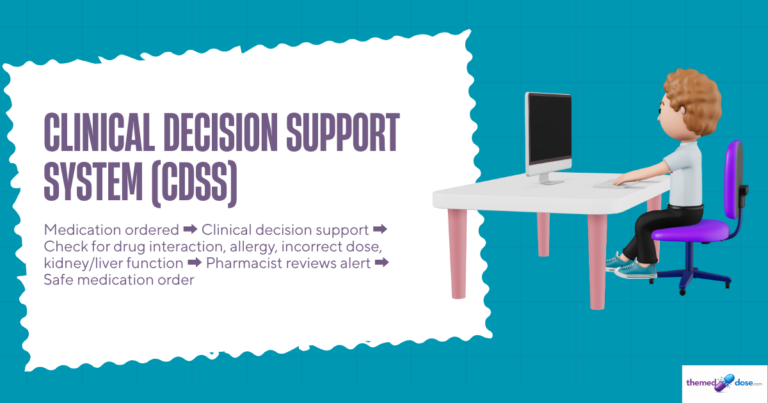
A benefit of the CDSS built into the EHR system is that it can alert the healthcare team of multiple things. They are used for various tasks such as leading diagnostic test ordering, popping up alerts for prevention and screening, and alerting pharmacists and providers regarding drug safety (Raven et al., 2025). Examples of alerts are for:
- Drug interactions
- Duplicate therapies
- Allergy warnings
- Dose range checking
- Renal dosing
- Hepatic dosing
- Pregnancy warnings
While some medications might be safe for much of the population, certain populations may be at risk for certain interactions in specific situations. For example, patients who have compromised kidney function or liver function will likely have to have renal dosing or hepatic dosing taken into consideration for safety.
It is important to note that these alerts are meant to assist, not replace, the clinical judgement of the pharmacist. The pharmacist must continue to review the start, continuation, or discontinuation of each medication the patient is taking.
Electronic Prescribing
With electronic prescribing, providers can put an order directly into the EHR. This helps to eliminate handwriting errors. Additionally, it allows for faster prescription transmission, which is incredibly useful if a patient needs a medication urgently. This is a great improvement in patient care. Electronic prescribing also reduces errors in the transcription itself. When information is moving on its own, fewer hands could accidentally alter the information. Lastly, if insurance will not cover a medication, the EHR can identify formulary alternatives.
Better monitoring through Laboratory Data
The doctors and nurses are not the only ones in the hospital to view the lab results when they come. The pharmacist uses lab results for multiple reasons. One reason is to identify cardiac function and ensure there is no bleeding in the body. A pharmacist may also need to know serum creatinine. Kidney function and liver enzymes will allow the pharmacist to be aware of any potential buildup of a drug in the body, and blood glucose levels are important to know in diabetes medication or insulin.
Supporting Medication Reconciliation and Benefits for Patients
Medication reconciliation is completed at multiple parts of the patient’s care. During hospital admission, a triage nurse is likely the first one to access the medication list and update it if needed. After hospital admission, the next time the reconciliation is done is during a transfer either to home or another location. During discharge, medications may have to continue or be stopped. If there are any changes on discharge paperwork, the nurse must let the patient know. The most frequent access to medication lists occurs during outpatient care visits. Every outpatient provider can be involved in reviewing the patient’s list. Read more about medication reconciliation HERE.
EHR systems have benefits for patients. Access to patient portals increases the ability for the patient to update their medication list and review instructions. They can also put in a refill request through the portal, making it easier to avoid gaps in their therapy. Overall, being more involved in their care could make the patient feel better about their whole situation.
The Pharmacist’s Role
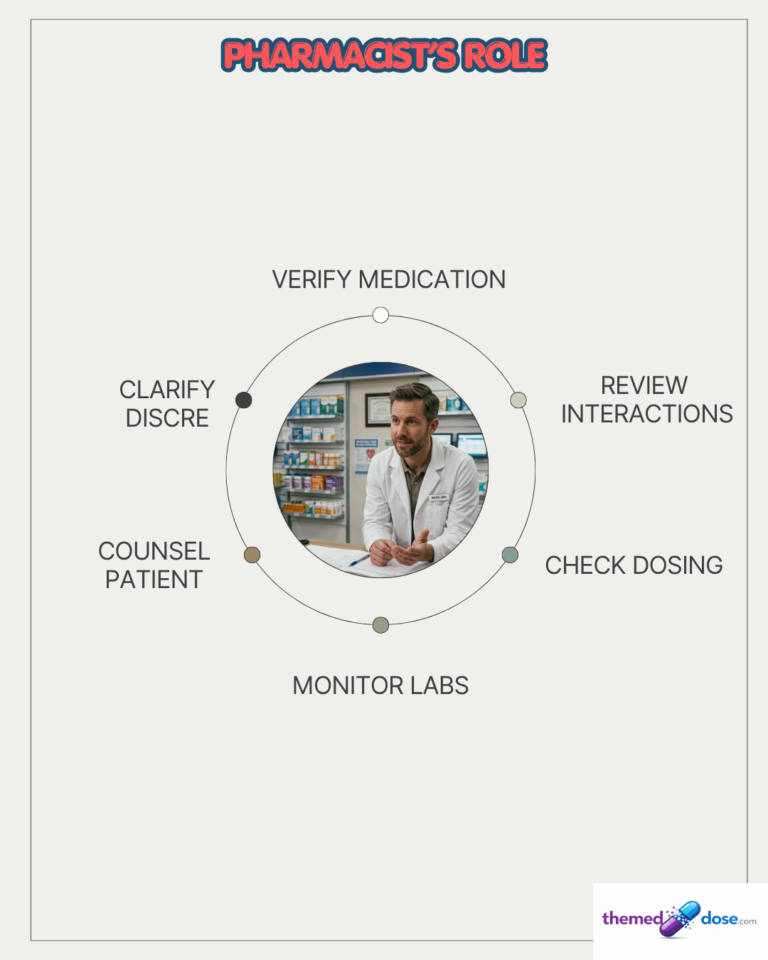
As noted above, the EHR and any system built into it does not replace the need for the pharmacist’s judgement. It is only meant to be a useful tool. The pharmacist must still review the medication order for appropriateness, assess for any interactions, evaluate the dosing, taking lab work and other factors into consideration, counsel patients if in the outpatient setting, and clarify any discrepancies caught.
Pharmacists should look out to make sure they are not experiencing overload or burnout, as this could cause more harm than good. With multiple information sources providing updates, the pharmacist must look at every note carefully to make sure that there is not missed patient information (Cahill et al., 2025).
Looking into the Future
Although EHR has undergone many advancements, there is still room for it to grow continuously. Artificial intelligence is rapidly being integrated into many aspects of our lives, and pharmacy is not excluded from that. Read more about artificial intelligence in pharmacy HERE. Predictive analytics and machine learning play a huge role in improving patient therapies and in anticipating any issues along the way. Personalized medicine considers the patient’s specific factors to allow for the most effective and safe care. Read more about personalized medicine HERE.
Conclusion
Electronic health records have transformed medication safety by alerting pharmacists to potential harm, allowing the patient to be more involved in their own care, and unifying where information is found. However, technology is only as effective as the healthcare professionals using it. Pharmacists remain essential in evaluating medication therapy, identifying potential risks, and ensuring each patient receives safe and effective treatment. As EHR technology continues to evolve, the partnership between advanced digital tools and clinical expertise will remain central to improving patient outcomes.
References
Cahill, M., Cleary, B. J., & Cullinan, S. (2025). The influence of electronic health record design on usability and medication safety: systematic review. BMC Health Serv Res, 25(1), 31. https://doi.org/10.1186/s12913-024-12060-2
Pereira, N., Duff, J. P., Hayward, T., Kherani, T., Moniz, N., Champigny, C., Carson-Stevens, A., Bowie, P., & Egan, R. (2024). Methods for studying medication safety following electronic health record implementation in acute care: a scoping review. J Am Med Inform Assoc, 31(2), 499-508. https://doi.org/10.1093/jamia/ocad231
Raven, K., Zhang, J., Vagliano, I., Jaspers, M. W., Peute, L. W., & Medlock, S. (2025). Determinants influencing medication-related alert handling in the electronic health record: A systematic review and meta-analysis. Int J Med Inform, 203, 106011. https://doi.org/10.1016/j.ijmedinf.2025.106011
Shermock, S. B., Shermock, K. M., & Schepel, L. L. (2023). Closed-Loop Medication Management with an Electronic Health Record System in U.S. and Finnish Hospitals. Int J Environ Res Public Health, 20(17). https://doi.org/10.3390/ijerph20176680
Author Bio
I am a healthcare professional and pharmacy technician with experience in pharmacy practice and medication-related topics. I am passionate about medication safety, healthcare education, and making complex healthcare information easily accessible. Through TheMedDose, I share practical insights on medications, pharmacy practice, and patient safety to help the public better understand the impact of medications in everyday care.
Pingback: Alert Fatigue in Healthcare: factors, Risks, and Strategies to Improve Patient Safety – themeddose
Pingback: When a Medication Error Doesn’t REach the Patient – the Importance of Near-Misses – themeddose