
You step out of the shower. The heat from the shower feels amazing, especially with the cold weather outside. The steam feels the greatest of all, and you feel like nothing else can beat this feeling. While you’re already in front of the cabinet, you decide this would be the best time to take your medication. You open the cabinet with the mirror completely fogged up without a second thought…but what if this humidity isn’t good for your medication?
Introduction
The obvious answer to where your medication should be stored may be at a place where it’s the most convenient to remember and take on time, but this isn’t always the case. Things such as heat, moisture, light, and improper storage can affect certain medications. Additionally, improper storage can increase the risk of accidental ingestion, especially for young children. When in doubt, you can take a look at the medication label or package insert for the medication-specific storage instructions.
Incidence of improper storage may be rising partly due to the fact that more medications are being prescribed and being stored after the treatment is done. You should be mindful of the accumulation; however, accumulation of these medications has the potential for misuse or exposure of the population to the ingredients 1. Many people may not know if their medication is appropriately stored to maintain the stability and sterility of the drug. The most common categories of medications stored at home are those being used; they are unused for reasons such as side effects, being unwanted, or expired 2.
The Basic Rule: Follow the Storage Instructions on the Label
There is no standard way all medications can be stored.
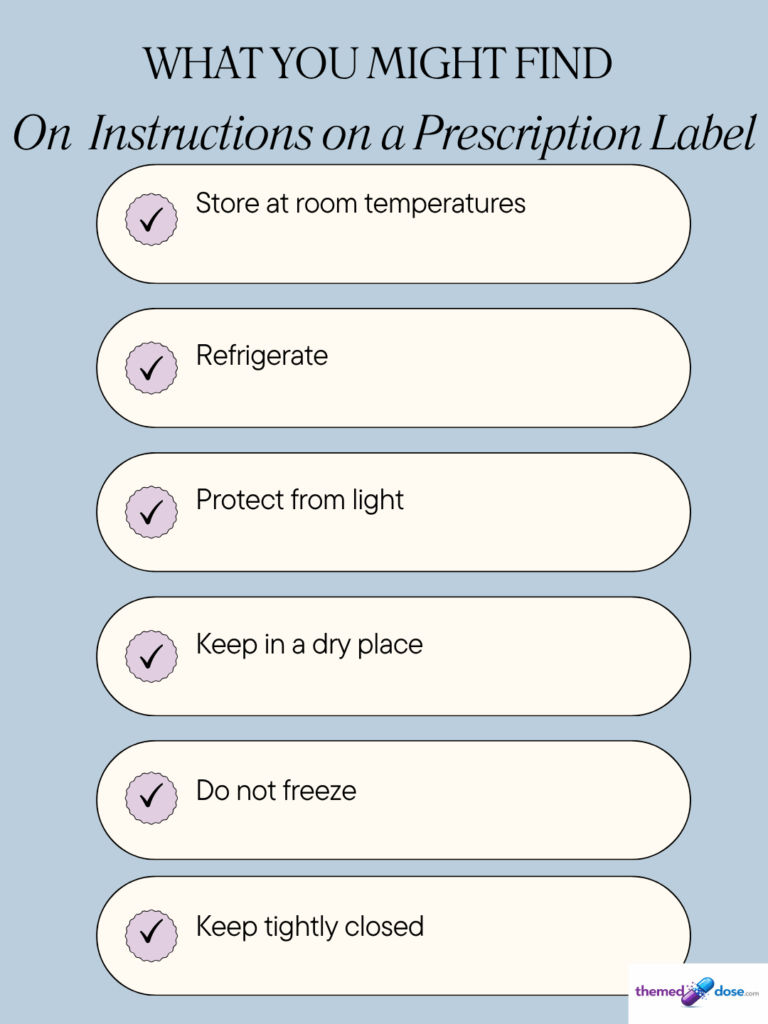
While it may be tempting to store all your medications in one consistent spot, you should not assume all medications can be stored the same way. For example, if you have a medication that has to be put in the fridge, and you want to store another medication that does not have that instruction with it due to convenience, it may not be safe to put both medications together. Improper storage leads to a potential increased risk for the patient to have a degraded medication or for the medication to cause an undesirable effect 2.
What does “Room Temperature” Actually Mean?
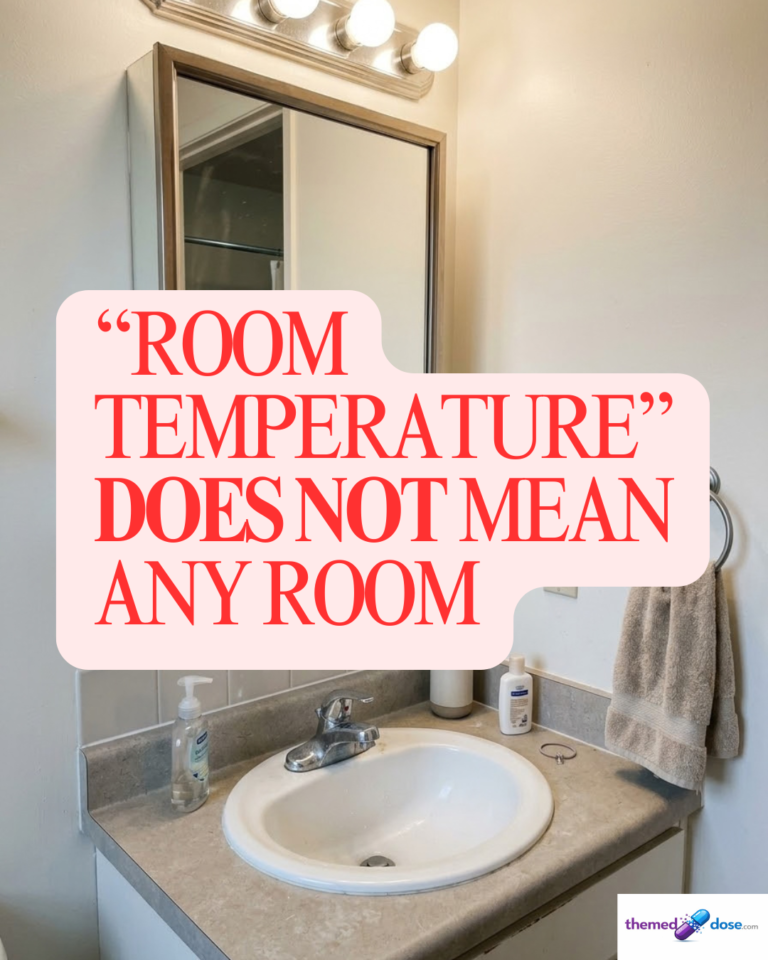
Room temperature doesn’t mean anywhere in the house. Room temperature refers to a controlled indoor environment—not simply anywhere that isn’t refrigerated. There are still various places that should be avoided, depending on the medication. Different rooms in the house may have different environments, such as the humidity in the bathroom after a shower or the heat given off by the stove in the kitchen. Places exposed to excessive heat and direct sunlight should be avoided. Additionally, areas with significant temperature fluctuations should be avoided.
Why the Bathroom Medicine Cabinet May Be a Bad Idea
Bathrooms can become very hot and humid from showers, making it an unfavorable environment for various medications. A medication may not be sitting directly in water, but repeated exposure to the humid environment created by showers can still be a concern for medications that are sensitive to moisture. Humidity can affect medications that are sensitive to moisture. The term “medicine cabinet” is familiar, but it doesn’t mean it’s an ideal storage location for a variety of medications. Ultimately, a cool, dry location away from children is often preferable, unless the medication has a different storage instruction.
Medications That Need Refrigeration
Some medications require refrigeration, while others should not be refrigerated. When in doubt, the patient can check the label or the package insert for specific temperature requirements. It is important not to assume that refrigeration is better for all medications, regardless of the written instructions. Freezing can damage some medications or affect their stability, so medications should not be frozen unless the product’s storage instructions specifically state that freezing is appropriate.
Patients should be careful about where refrigerated medications are placed, especially if the household has children. Refrigerated medications should also be stored in a location where they cannot easily be mistaken for food or beverages, particularly in households with young children. Lastly, if a refrigerated medication is accidentally left out, patients should check the manufacturer’s instructions or contact their pharmacist for next steps to determine if it is still safe to take.
Protecting Medications from Heat, Light, and Moisture
The most common locations to store medications were the bathroom, bedroom, and kitchen; however, the ideal environment for most room-temperature medications is 59°F to 86°F and has a humidity level below 60% 2. This makes the kitchen not ideal for temperature- and humidity-sensitive medications, the bedroom not a good location for humidity-sensitive medications, and the bathroom inappropriate for temperature- and humidity-sensitive medications 2.
Heat
Medications can be exposed to heat in various ways. Many people keep their medication in their car for convenience, but this could potentially lead to the medication being exposed to a dangerous amount of heat. If stored in the kitchen, medications can be exposed to heat from the oven or the stove. Commonly, patients like to keep medication on the counter or kitchen table as they feel that seeing it will remind them to take it; however, it is important to keep the medication away from direct sunlight. Heating vents also pose a potential risk of exposing the medication to too much heat.
Light
There are some medications that are sensitive to light, regardless of whether it is direct or not. Many of these medications come in vials or bottles that protect the medication from the light in the room. For these drugs, specifically, it is recommended to keep them in their original packaging when instructed.
Moisture
Moisture can be found in various parts of the home. Bathrooms can have high humidity from hot showers. Kitchen sinks can also emit humidity, and medications should be kept at an acceptable distance from the sink. Keep medication lids and tops securely attached, as humidity in the air can enter the container if there’s an opening. Keeping the drug container tightly closed can go a long way to preserving the medication.

Should you Keep Medications in Their Original Containers?
Medications should remain in their original containers whenever possible. In addition to preserving the appropriate environment, the original container provides the medication name and strength to avoid any confusion. Additionally, the original container contains the expiration information, the directions, and anything else the pharmacy labels per standard.
The original container includes the important storage instructions. This is important, as proper storage allows the medication to be preserved up until its date if given the correct environment. Pharmacies include child-resistant packaging on the medication, which is helpful as it’s an extra barrier in case a child tries to open the container.
Medication Storage Around Children and Pets
Lee et. al. found that most of the high-risk medications for children and adolescents were stored on the counter for some of the study participants. Counters are easily accessible, and it’s easy to forget that children or pets can be curious3. The best and safest way to store medication is away from children’s and pets’ sight and reach. Many children are curious, so simply keeping the medication “out of reach” may not be enough to ensure a child doesn’t ingest the medication. “Child-resistant” packaging does not mean that it is completely foolproof to a child; therefore, it is important to find a location where they will not see the bottle or vial at all. Even if all of your medication is safely kept, it is important to keep in mind that visitors may keep their medication within reach of children.
Pets can also find themselves to be curious about a medication bottle or vial. While certain medications may not have too big an effect if accidentally ingested, some medications can be extremely dangerous to animals. Keep medications secured and out of sight rather than assuming a child or pet cannot access them.
What About Medications in Your Purse, Backpack, or Car?
The most common locations to store medications are in the bathroom, bedroom, and kitchen 2. There are other locations that individuals like to keep their medications, however. Keeping medications in your purse, backpack, or car gives them an increased chance of temperature exposure, both hot and cold, as well as direct sunlight. Some environments can also be very humid, which can affect the medication’s ability to work. It is well understood that medications should be accessible during travel, but it is still important to pack them appropriately given the environment you might be traveling in.
What if Medication Was Stored Incorrectly?
Mistakes can happen when it comes to storing your medication, so knowing what to do in that situation is important. First, it is important not to assume; don’t assume that the medication is absolutely safe to take, but also don’t assume it is absolutely ruined, either. The first place you can check once you find that the medication was improperly stored is the medication label or package insert. Here, it will likely explain what to do and how to determine if the medication is still safe or not. For example, if a medication needs to be refrigerated, there may be a certain amount of time it is okay to be out of the fridge.
If you are still unsure about the safety and efficacy of your medication, you can also contact your pharmacist. Although you should not assume simply from the appearance alone, do not take medication that appears altered, damaged, or contaminated without asking a pharmacist. The physical change may be due to an underlying chemical change that could potentially lead to long-term consequences.
Conclusion
Your medicine cabinet isn’t automatically the best place for your medications, and proper storage matters. Before choosing where to store your medication, check its label or package insert for specific storage instructions, or follow the instructions given by the pharmacy. Keep medications away from excessive heat, moisture, and direct sunlight when applicable, and especially keep them away from children. A few extra seconds spent on the storage instructions can help protect the medication, your health, and your loved ones.
References
- Constantino VM, Fregonesi BM, Tonani KAA, et al. Storage and disposal of pharmaceuticals at home: a systematic review. Cien Saude Colet. Feb 2020;25(2):585-594. Estoque e descarte de medicamentos no domicilio: uma revisao sistematica. doi:10.1590/1413-81232020252.10882018
- Funk OG, Yung R, Arrighi S, Lee S. Medication Storage Appropriateness in US Households. Innov Pharm. 2021;12(2)doi:10.24926/iip.v12i2.3822
- Lee S, Schommer JC. Medication Use and Storage, and Their Potential Risks in US Households. Pharmacy (Basel). Feb 9 2022;10(1)doi:10.3390/pharmacy10010027
Author Bio
I am a healthcare professional and pharmacy technician with experience in pharmacy practice and medication-related topics. I am passionate about medication safety, healthcare education, and making complex healthcare information easily accessible. Through TheMedDose, I share practical insights on medications, pharmacy practice, and patient safety to help the public better understand the impact of medications in everyday care.