
You are used to your daily medication working well every day…until one day it feels a little off. You don’t recall doing anything different, and you try to see if there is anything wrong with the medication itself. You look at the bottle and see the expiration date is fine; you try to search if there have been any recent recalls. One thing you may not think of, though, is that maybe it’s something you ate or drank that day. Medication interactions can come in various forms, and chances are, you’ve experienced one.
Introduction
Medication interactions are more common than many people realize. They can occur not only between prescription medications, but also with over-the-counter medicines, vitamins, herbal supplements, certain foods, and alcohol, showing that it is not always another prescription drug that could interfere with the first medication. One of the main causes of medication interactions is that a large number of patients are unaware of the dangers of potential interactions. One of the leading causes of the lack of awareness is that many OTC medications, vitamins, and supplements are marketed as “safe” or “natural”. Natural does not always mean harmless, though. In this blog post, we will dive into topics such as going over what a medication interaction is, the types of interactions, the populations that are most at risk, warning signs of a medication interaction, and how to reduce the risk of an interaction.
What is a medication interaction?
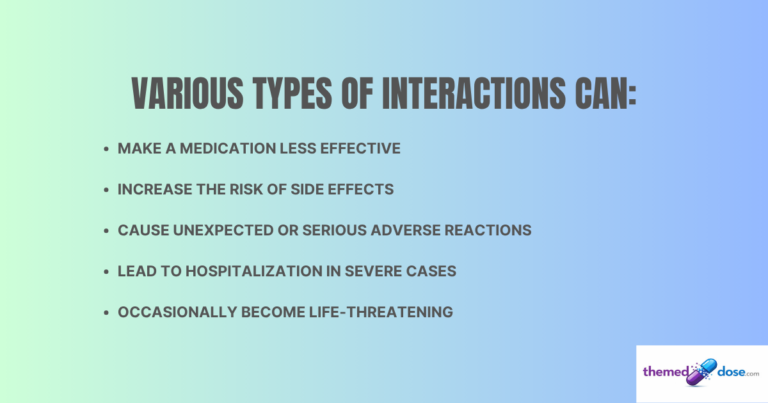
An interaction occurs when one substance causes a change in another substance. A medication interaction happens when another substance changes the way your medication works. It may make the medication less effective, increase side effects, or even cause dangerous health complications.
Types of interactions
Drug-to-Drug Interactions
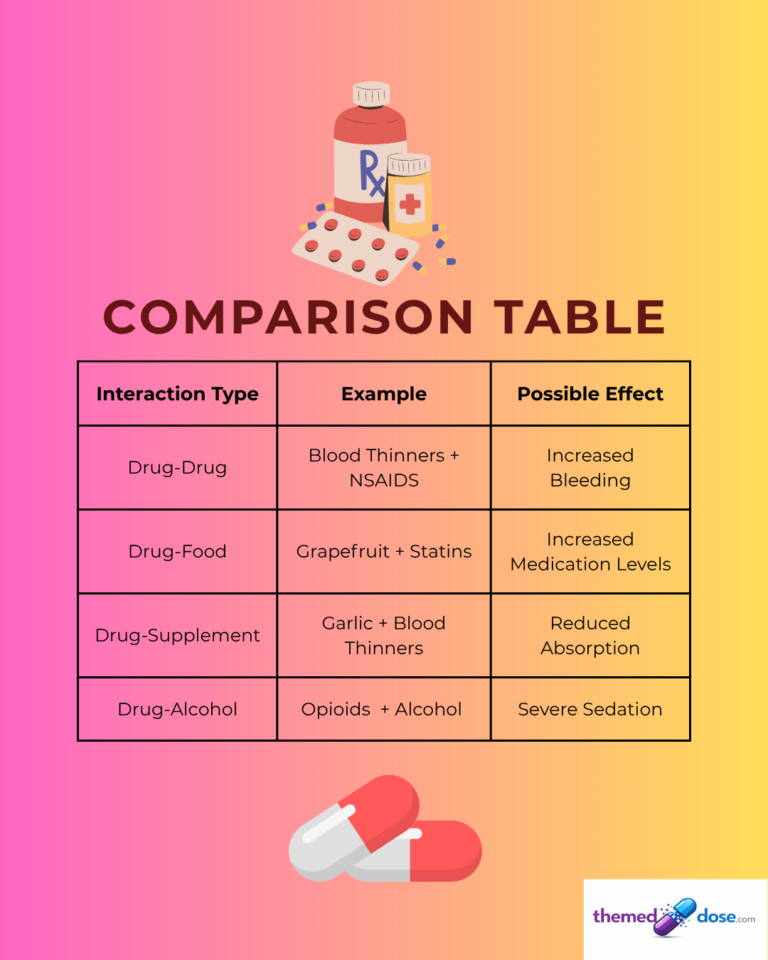
Taking multiple drugs can lead to an increased chance of a drug-to-drug interaction. Ratna Tuladhar et al, “drug-drug interactions are defined as two or more drugs interacting in such a manner that the effectiveness or toxicity of one or more drugs is altered on administration of the other. There is an increased chance of interactions with multidrug therapy (Ratna Tuladhar et al., 2021). Some examples of possible drug-to-drug interactions include blood thinners with NSAIDs and certain antibiotics with heart medications. Taking pills that interact could lead to reactions such as increased drowsiness or one or both medications losing effectiveness. Other potential consequences of drug-to-drug interactions could be increased bleeding and heart rhythm changes. Although many people commonly think of two drugs interfering with each other, various other interactions can occur. Potential drug-to-drug interactions (pDDIs) are preventable with the proper screening. DDIs can lead to morbidity, mortality, increased time for hospital stay, rising health care costs, and decreased quality of life (Rajj et al., 2024).
Drug-to-Supplement
Although the media likes to promote supplements as a healthy addition to a regular diet, they may not be completely harmless when combined with certain medications. The US FDA defines dietary supplements as oral products that contain ingredients including vitamins and minerals (Grzesk et al., 2021). Common supplements that interact with drugs are:
- Fish Oil
- Calcium
- Garlic
- Ginseng
- Iron
A very important aspect of this is that many patients are unaware of the potential risks and may not know that they should reveal any supplements taken to their healthcare provider.
An example of drug-supplement interactions between cardiac medications and supplements.
Drug-to-Food and Drug-to-Alcohol Interactions
It may be shocking to know that even your diet can affect some drugs. For example, grapefruit can interfere with the effectiveness of statins and some blood pressure medications, dairy products can affect some antibiotics, and high-fiber meals can impact some thyroid medications. Drug-to-food interactions affect the pharmacokinetics and pharmacodynamics of the drug in the body (Advinha et al., 2024). Alcohol, especially if combined with sleep medications, anxiety medications, opioids, or diabetes medication, can cause serious effects. If any questions arise regarding medication interactions, a person should contact their healthcare provider or pharmacist.
Who is Most at Risk for Medication Interactions?
Everyone is at risk for a potential medication interaction; however, some populations are more vulnerable than others. Older adults commonly experience polypharmacy. With polypharmacy, it is easy to lose track of what medications are taken and when they are taken. Additionally, the more medications that are taken, the more likely it is to forget to mention one at the doctor’s office when another drug is being discussed. Read more about polypharmacy here. Although the older population is more vulnerable, anyone who is taking multiple medications is at a higher risk than those who do not.
Individuals with chronic disease are also more prone to experience a medication interaction than those who do not have a chronic illness. This could be due to many factors, but what I commonly see in my experience as a pharmacy technician is that the patient either has adopted so much “muscle memory” that they simply forget that they are actively taking the medication, or it could be because the longer someone is taking a medication, the more likely they are to undergo an interaction.
Patients who take supplements are at a higher risk of undergoing a medication interaction, as they may not be aware that supplements could change how a drug works. Lastly, as mentioned above, a drug eventually gets metabolized. When a person’s liver or kidneys are affected, this changes the way metabolism occurs.
Warning Signs of a Medication Interaction and Risk Reduction
It is vital to know the signs of a medication interaction. If an individual suddenly becomes dizzy, extremely drowsy, confused, experiences a rapid heartbeat, or has difficulty breathing, it could be a sign of a potential medication interaction. Depending on the warning sign, a patient should contact their healthcare provider or go to the nearest emergency room. To avoid signs and symptoms of a medication interaction, it is important to do everything possible to reduce the risks. A common tactic is to keep an updated medication list of all medications and supplements taken, along with the dose and frequency. Using a single pharmacy when possible, reduces the risk of an interaction. A patient must also read medication labels carefully to ensure appropriate use of the medication. Lastly, anyone interested in taking a new supplement should always run the idea by their physician.
Conclusion
Medication interactions are more common than many people realize, and they can involve much more than prescription medications alone. Over-the-counter medications, vitamins, herbal supplements, certain foods, and alcohol all have the potential to change how a medication works. While some interactions are mild, others can reduce a medication’s effectiveness, increase side effects, or lead to serious health complications.
Fortunately, many medication interactions are preventable. Keeping an up-to-date list of every prescription medication, over-the-counter product, vitamin, and supplement you take, using one pharmacy whenever possible, and discussing any new medications or supplements with your healthcare provider or pharmacist can significantly reduce your risk. Never assume that a product labeled “natural” is automatically safe to combine with your medications.
Being informed is one of the most effective ways to protect your health. If you ever have questions about whether two medications, a supplement, or even a particular food may interact, don’t guess; ask your pharmacist or healthcare provider. A quick conversation today could prevent a serious medication-related problem tomorrow.
Reference
Advinha, A. M., Fernandes, J. P., & Perdigao, M. (2024). Food-drug interactions risk management: An emergent piece of pharmacovigilance systems. Pharmacol Res Perspect, 12(4), e1245. https://doi.org/10.1002/prp2.1245
Grzesk, G., Rogowicz, D., Wolowiec, L., Ratajczak, A., Gilewski, W., Chudzinska, M., Sinkiewicz, A., & Banach, J. (2021). The Clinical Significance of Drug-Food Interactions of Direct Oral Anticoagulants. Int J Mol Sci, 22(16). https://doi.org/10.3390/ijms22168531
Rajj, R., Schaadt, N., Bezsila, K., Balazs, O., Jancso, M. B., Auer, M., Kiss, D. B., Fittler, A., Somogyi-Vegh, A., Telessy, I. G., Botz, L., & Vida, R. G. (2024). Survey of Potential Drug Interactions, Use of Non-Medical Health Products, and Immunization Status among Patients Receiving Targeted Therapies. Pharmaceuticals (Basel), 17(7). https://doi.org/10.3390/ph17070942
Ratna Tuladhar, L., Lal Shrestha, S., Bimali, S., Bhusal, S., & Khadka, P. (2021). Drug-drug Interactions between Hypoglycemic and Non-hypoglycemic Medication in Diabetic Patients with Comorbidities in a Tertiary Care Center: A Descriptive Cross-sectional Study. JNMA J Nepal Med Assoc, 59(243), 1125-1130. https://doi.org/10.31729/jnma.7080
Pingback: Alert Fatigue in Healthcare: factors, Risks, and Strategies to Improve Patient Safety – themeddose