
You wake up not feeling well and stumble into the bathroom. As you open up the medicine cabinet, you are ready to grab anything that will make your stomachache go away. You grab something that you know will put an end to the stomachache without looking at the bottle first. Upon relief, you go to put the bottle away only to see an expiration date that has already passed. You worry that there might now be consequences.
introduction
Expiration dates are easy to forget on medications, especially those that have been sitting in the medicine cabinet for a long time. In the years between 2015 and 2020, the number of prescriptions and purchases of over-the-counter medications increased; however, many of the medications eventually expired after the medication was sitting there for a long period of time (Falk & Sexton, 2023). Patients who commonly use the same medications may forgo checking the expiration dates on all medications in the residence, but this is not done maliciously. The patient rarely lets medications expire on purpose; some patients may be nonadherent or could potentially be keeping them for future purposes (Falk & Sexton, 2023). For more on medication adherence, click here. The concept of expiration dates could simply be forgotten, or maybe the individual may not realize the dangers of going beyond the expiration date. So, then, that brings up the question: “Are expired medications safe to take?”. This blog post will cover what expiration dates mean, the potential dangers of taking expired medications, what kinds of medications should absolutely be avoided after the expiration date, and how to properly dispose of the unused medication in a manner that keeps everyone safe.
what does an expiration date actually mean?
We keep hearing it for everything, from milk in our fridge to the drugs in our medicine cabinet. Many of us simply know it as “the date that the item must be thrown away”, and we automatically dispose of the item if the current date is beyond the date printed on it. When it comes to medications, the date means much more than what is printed on the packaging (Sharma et al., 2022). Regulations include having the expiration date provided on their products before marketing. The main goal of stating an expiration date on the drug packaging is that the company has tested to see how long the drug will be stable once packaged.
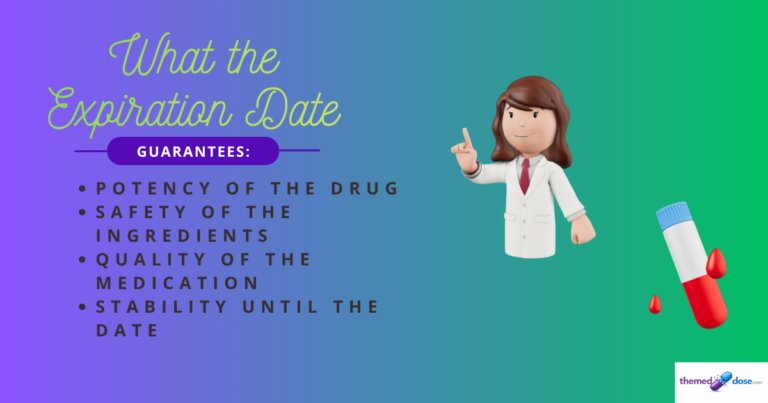
It is not an absolute set date; however, the date written is the estimated date by which the above factors could be guaranteed. The FDA requires certain standards for the drug, and the manufacturer must conduct stability studies. Factors they test for include temperature and humidity levels at which the medication loses stability.
so, can i still take a medication that is expired?
Short answer: It is not advisable to take medications after their expiration date. There are various risks to taking drugs beyond their expiration date, including:
- Reduced effectiveness
- Improper treatment
- Worsening illness
- Bacterial contamination (in those that apply)
- Degraded ingredients
When drugs are studied in clinical trials, one of the significant factors tested is the effectiveness of the medication to treat a certain illness. Stability tests serve the purpose of monitoring and observing the quality of the Active Pharmaceutical Ingredients (API) and Finished Pharmaceutical Products (FPP) when exposed to variables such as environmental conditions, API and excipient interactions, packaging materials, shelf life, or container closure system during a certain period (Gonzalez-Gonzalez et al., 2022). The effectiveness of the medication may begin to decline, making it difficult to know whether it will provide the intended therapeutic effect. While this may seem harmless, it could potentially lead to dangerous consequences. For example, an antibiotic may not fight the infection properly after a patient has been suffering from one. When the pharmacist hands them the prescription, it might be tempting for them to think that they have some at home prescribed and not taken and may not have to get the new one. If an antibiotic has lost potency, it may not adequately treat the infection. Incomplete treatment can contribute to treatment failure, and inappropriate antibiotic exposure may increase the risk of antimicrobial resistance.
The way the medication is stored also plays a big role in the impact of going past the expiration date. Poor storage can affect the medication’s life, leading to inaccuracy of the expiration date. Medicine cabinets, cars, and garages are not advisable locations to store medications due to the chance of extreme heat and humidity. It is also important not to put the medication in direct sunlight, as many important drug ingredients are sensitive to light. Moving medications to another storage container could raise questions about stability, as the directions, information, and vial of the drug are no longer available.
disposing of expired medications safely
In my experience, how to safely dispose of expired medication seems to be one of the most common questions patients have. There have been instances where they come in with a whole bag of medication bottles, asking if the pharmacy can dispose of the medication safely. The FDA recommends implementing drug take-back programs and/or medication drop-off boxes (Falk & Sexton, 2023). If the local pharmacy does not dispose of medications for patients, there are various other methods to do so.. The FDA also has a “flush list” for medications that could safely be flushed down the toilet without any long-term effects.
conclusion
Although research is still being conducted to determine the true impact of the expiration date of a drug, there is no reliable way for people to know whether an expired medication is still safe or effective. A good way to mitigate any risks of taking expired medications is to conduct regular checks for expiration dates, store medications in the recommended conditions, and dispose of expired medications using guidelines. If anyone is unsure of the proper disposal method, they can always reach out to their pharmacy.
references
Falk, C. L., & Sexton, S. M. (2023). Assessing Perceptions and Medication Disposal Habits in Rural Michigan. Innov Pharm, 14(2). https://doi.org/10.24926/iip.v14i2.5433
Gonzalez-Gonzalez, O., Ramirez, I. O., Ramirez, B. I., O’Connell, P., Ballesteros, M. P., Torrado, J. J., & Serrano, D. R. (2022). Drug Stability: ICH versus Accelerated Predictive Stability Studies. Pharmaceutics, 14(11). https://doi.org/10.3390/pharmaceutics14112324
Sharma, S., Sharma, A. K., Moe, H. W., Khanapure, A., & Mohan, P. (2022). A study to investigate the chemical potency, physical stability, and efficacy of analgesic agents over a period of two years post their expiry date. Med J Armed Forces India, 78(Suppl 1), S194-S200. https://doi.org/10.1016/j.mjafi.2021.03.015