
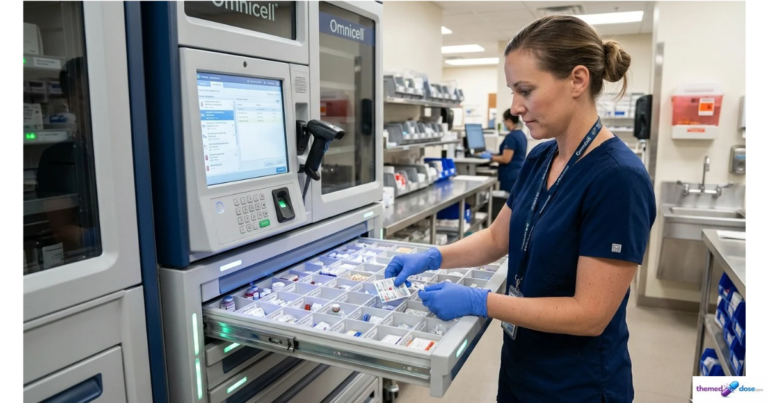
You’re a pharmacy technician who is stocking medications in the automated dispensing units on the nursing unit. As you fill in the medication in the appropriate locations, you think about how this medication will likely be pulled by a nurse to give to a patient during the shift. The whole process seems simple when you look at it at a surface level. You wonder if the use of automated dispensing cabinets actually makes medication filling and administration safer.
Introduction: When Technology Becomes Part of the Medication Distribution Process
The process of filling and pulling a medication from the automated dispensing cabinet seems straightforward, but there is a lot that goes into the process. Medication is stored securely, access is controlled, and transactions are electronically documented. The pharmacy staff may be given permissions that the nursing staff is not, and vice versa. Automation can improve medication distribution, but it does not eliminate medication errors. All team members involved in the medication’s pathway are responsible for ensuring patient safety. Automation changes the systems, workflows, and human interactions in which errors can occur, but should not be fully relied on.
What are Automated Dispensing Cabinets?
Automated dispensing cabinets, or ADCs, allow for improved patient care, efficiency, and accuracy of the dispensing system, and provide evaluation of the user interactions1. They can help to reduce medication errors, storage errors, and time taken for administration 2.
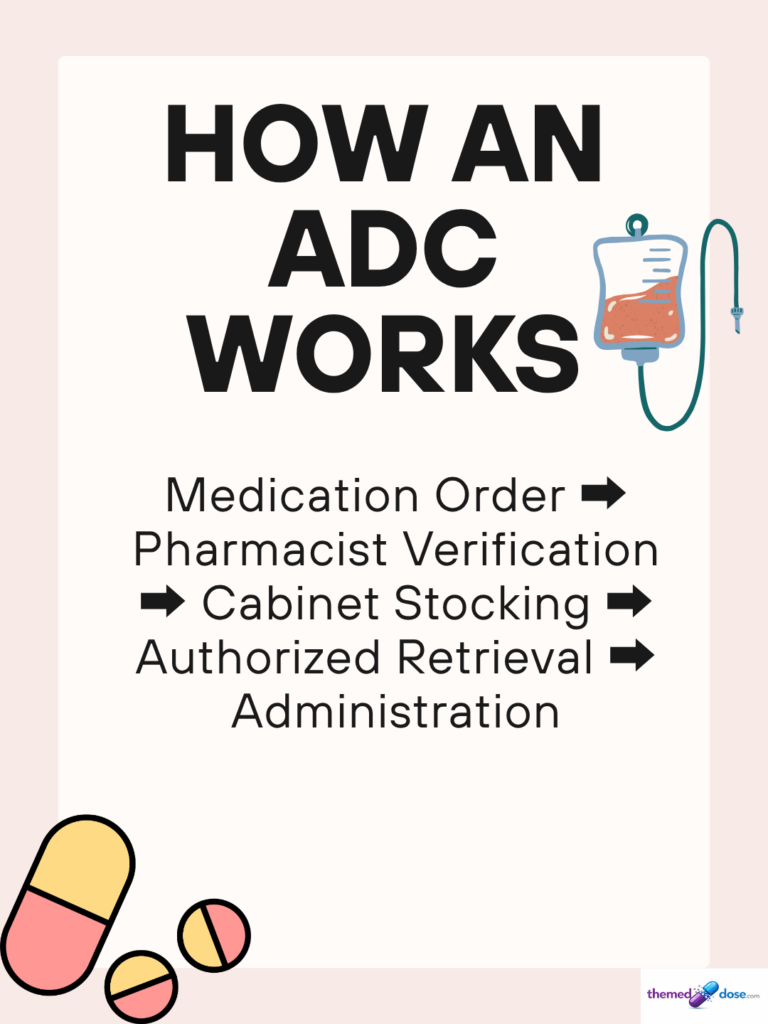
The workflow of automated dispensing cabinets includes:
- Medication orders are entered into the hospital’s electronic system
- Pharmacy reviews and verifies orders according to the institution’s workflow
- Medications are stocked in the automated dispensing cabinets (ADCs)
- Authorized staff access the cabinet
- The medication is selected and retrieved
- Inventory and transaction records are updated
Not every ADC operates identically. Some systems use patient-specific profiling and pharmacy verification, while others allow more immediate access through defined workflows.
The Potential Safety Benefits of ADCs
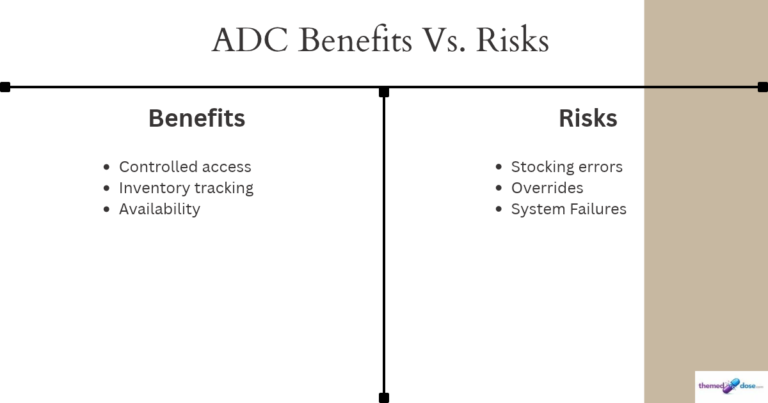
ADCs offer several potential benefits. The first is that they provide controlled medication access. There is user authentication, role-based access, transaction records, and improved accountability. Next, there is improved medication inventory management, which includes real-time inventory visibility, replenishment notifications, reduced manual inventory tracking, and better visibility into medication utilization. ADCs may reduce delays for medications available at the point of care. There would be less dependence on manual delivery for certain medications, and it would allow for potentially improved workflow efficiency. Improved documentation is surely a plus of using ADCs, since it allows for electronic records of medication access, identification of the user retrieving medications, and audit trails for medication transactions. It is important to note, however, that better documentation and inventory control do not automatically mean fewer patient medication errors.
Where the Risks Begin: How ADCs can Contribute to Medication Errors
Stocking errors may occur when medications are placed in the wrong compartment, incorrect strengths are stocked, or verification processes are inadequate. Look-alike and sound-alike (LASA) medications can also potentially lead to medication errors. Drugs can have similar names or packaging, multiple strengths can be stored in proximity, and there is a danger of selecting the wrong medication from an incorrectly configured cabinet, all leading to risks. Read more about LASA drugs here.
Medication overrides are another potential source of risk. Although ADCs may incorporate safeguards such as medication selection restrictions and patient-specific profiling, certain medications can be retrieved through an override process that bypasses the usual pharmacist verification workflow. Overrides may be necessary when timely medication access is clinically important; however, inappropriate or excessive use can weaken safety safeguards and increase the risk of medication selection errors. Healthcare organizations should establish clear override criteria, educate staff on appropriate use, and routinely monitor override activity to identify potential safety concerns.
Incorrect medication returns may also lead to a risk of a medication error. An unused medication can be returned to the wrong compartment, leading to the potential for another team member to take it mistakenly. Improper returns also create inventory discrepancies and potentially introduce medication selection errors.
The Human Factor: Technology Cannot Replace Clinical Judgement
Multiple people interact with ADCs throughout the day:
- Pharmacists are responsible for medication review and oversight
- Pharmacy technicians are involved in inventory management and restocking
- Nurses retrieve and administer medications
- Healthcare administrators are responsible for policies and implementation
- IT personnel are responsible for system integration and maintenance
Hospital staff should be cautious about becoming overly dependent on automated systems. Although technology is a good tool to have, nothing should replace the expertise of a healthcare professional. Noting the amount of pressure the staff is under is also important. With growing pressure, the staff may be more likely to turn to workarounds to alleviate some of the high pressure placed on them. Lastly, employees should be adequately trained to recognize system limitations and be aware of what the system can miss when checking for errors.
What Happens When a Cabinet Fails?
There are numerous reasons why a cabinet may fail, and the staff should be aware to look out for them. These include:
- Network interruptions
- Software malfunctions
- Hardware failures
- Incorrect medication database updates
- System upgrades that disrupt normal operations
- Emergency medication access during downtime
A bulletin published by ISMP Canada in July 2025 explains a situation where a database corruption incident affected system-wide cabinet functionality during an ADC upgrade at a hospital network. Fortunately, emergency preparedness measures helped mitigate potential patient harm. This bulletin highlighted the need for downtime procedures, backup medication distribution processes, clear communication between pharmacy and nursing, emergency access protocols, testing and validation before system upgrades, and defined responsibilities during system outages3.
How Can Hospitals Make Automated Dispensing Safer?
The hospital administration, IT, and staff can all play a role in making the automated dispensing system safer to use. The following are some examples:
- Barcode verification during stocking: helps prevent incorrect medication placement
- Patient-profiled dispensing: supports pharmacist verification before removal
- Individual locked compartments: limits access to unintended medications
- Override monitoring: identifies inappropriate or excessive overrides
- Routine inventory audits: helps identify expired, misplaced, or missing medications
- Staff competency training: reduces unsafe workarounds and improper use
- Downtime preparedness: maintains medication access during system failures
- Regular system optimization: addresses outdated configurations and workflow problems
ADC safety requires cooperation between pharmacy, nursing, IT, and hospital leadership.
Are ADCs Actually Making Medication Distribution Safer?
There is no absolute answer to this question, as the ADCs can improve safety but cannot guarantee it. It needs to be supported by appropriate controls, oversight, and well-designed workflows. What is known, however, is that ADCs make medication access faster, improve medication inventory control, and reduce certain dispensing risks. It can help to prevent errors from reaching the patients, but all members of the healthcare team involved in medication management are responsible for using their own judgment as well.
Conclusion: Automation Should Support Medication Safety, Not Define It
Automated dispensing cabinets have changed how hospitals store, manage, and distribute medications. They offer meaningful advantages to inventory control, medication access, and transaction tracking. However, automation alone cannot eliminate medication errors. The safety of ADCs depends on how they are configured, how medications are stocked, how overrides are managed, and how healthcare professionals interact with the technology. Ultimately, the goal should not simply be to automate medication distribution. It should be to create a medication-use process in which technology and human oversight work together to protect patients.
References
- Cello R, Conley M, Cooley T, et al. ASHP Guidelines on the Safe Use of Automated Dispensing Cabinets. American Journal of Health-System Pharmacy. 2022;79:e71–e82.
- Zheng WY, Lichtner V, Van Dort BA, Baysari MT. The impact of introducing automated dispensing cabinets, barcode medication administration, and closed-loop electronic medication management systems on work processes and safety of controlled medications in hospitals: A systematic review. Res Social Adm Pharm. May 2021;17(5):832-841. doi:10.1016/j.sapharm.2020.08.001
- Institute for Safe Medication Practices Canada. Emergency Preparedness Mitigates Patient Harm during Failed Deployment of Upgraded Automated Dispensing Cabinets. Accessed November 20, 2026. https://ismpcanada.ca/bulletin/automated-dispensing-cabinets/
Author Bio
I am a healthcare professional and pharmacy technician with experience in pharmacy practice and medication-related topics. I am passionate about medication safety, healthcare education, and making complex healthcare information easily accessible. Through TheMedDose, I share practical insights on medications, pharmacy practice, and patient safety to help the public better understand the impact of medications in everyday care.