We have all received advice we didn’t ask for. Imagine you have a cold and reach for the cold medicine, only to be stopped and told to have some ginger tea instead. This would make anyone think about what the “correct” remedy is. Following this, we will discuss common medication myths and misconceptions to determine which may be true and which could be harmful.
Introduction
Everyone always strives to do the “best thing” or the “right thing”, but that could be hard to judge. When it comes to illnesses, many have their own beliefs on what the “correct way” to treat an illness is and what the “incorrect way” is. The major concern of healthcare providers, pharmacists, and researchers, however, is that many misconceptions and myths exist about medication. It is vital for everyone involved, including the patient, to look into the true facts about medication versus the myths.
Various factors contribute to the widespread beliefs of medication myths. This ranges from small posts shared on social media to possibly a celebrity on TV talking about a new remedy they recently started using. The myths go beyond the thought of “natural is better”; misconceptions also include that it’s okay to stop medication when you feel better, it is okay to miss a few doses, and that generic drugs do not work as well as the brand-name.
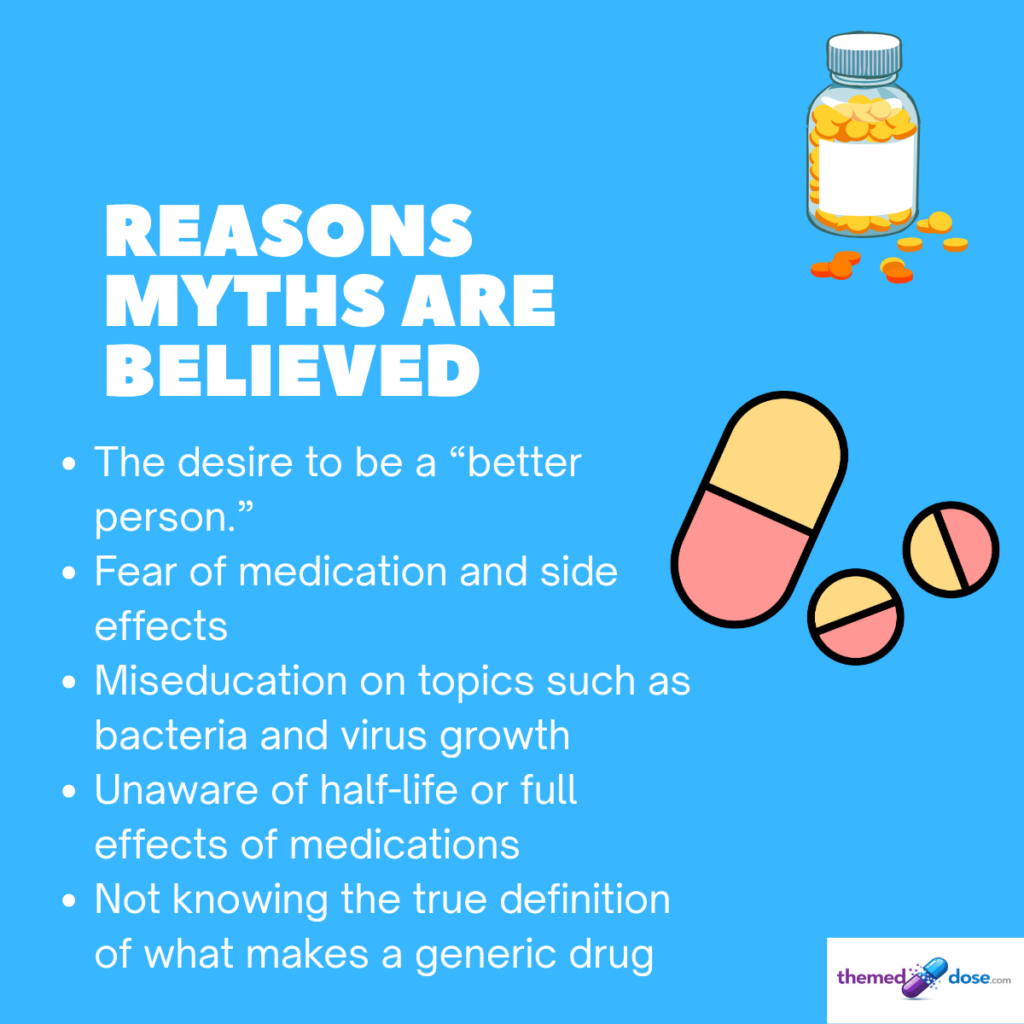
Thinking of why myths are easier to believe is a complex thought. Using my experience as a pharmacy technician, I tried to brainstorm possible reasons why myths are easier to believe and came up with:
Common Medication Myths and Misconceptions
It's Okay to stop medcations when you feel better
I recall reading a meme online once that stated something along the lines of that the best way to summon your friend who is a nurse is to tell them that you stopped taking your antibiotics because you feel better. The reasoning behind the reaction of this “nurse friend” is that stopping medication early could be very harmful. There is a possibility that the illness will come back after stopping medication early, regardless of how the patient feels.
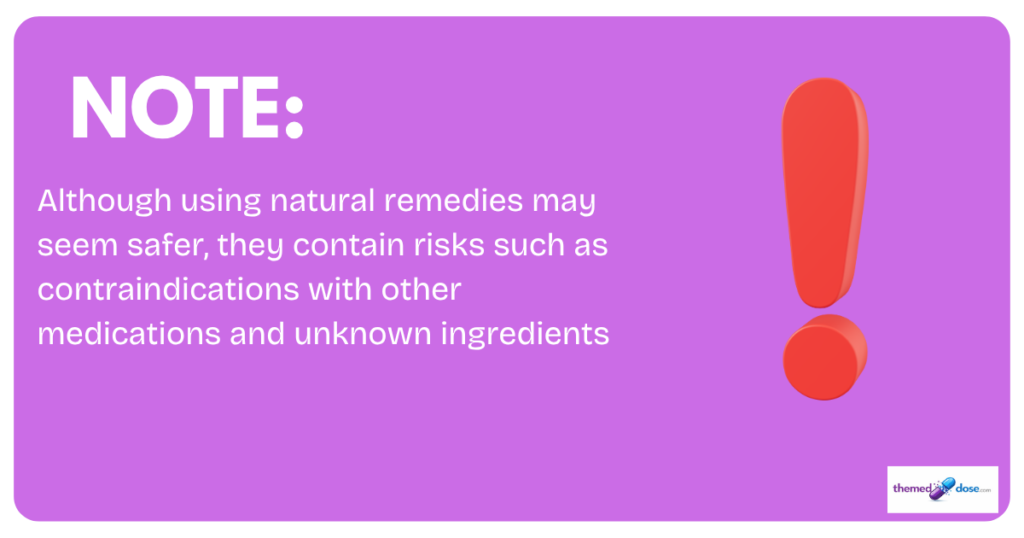
Natural Remedies are Always Safer
Whether or not you believe in “natural is always better”, we have all heard someone push for a natural alternative to almost every condition known. Herbal supplements have increased in use within the last 20 years in the United States. In contrast to conventional drugs, herbal supplements are not overseen by the FDA. This leads to potential concerns such as ingredients, contaminants, and possible drug interactions (Hassen et al., 2022). The push for natural was partly driven by fear of uncomfortable side effects. Additionally, numerous influencers and celebrities are promoting products on TV and online. This is an excellent form of marketing, as it allows for a widespread influence of products.
There is a recent drive to go back to traditional methods to treat conditions. Older traditions push for a natural remedy, focusing on the science behind the ailment and treatment. A benefit of choosing natural remedies is having more control over when you can receive treatment. Many pharmacy patients become frustrated when they cannot make it to the pharmacy during business hours. Finding a natural remedy at home gives more flexibility and control.
It's Okay to Miss a Few Doses
It is very understandable to believe that a skipped dose will not cause too much harm, especially when taking the medication for a long time. There are many medications where even missing one dose could lead to the medication being ineffective, for example, birth control pills. Contraceptive pills have to be taken correctly and consistently to prevent pregnancy. When the dose is missed by more than 3 hours, it is considered a missed pill. Following this, it is recommended to either use a condom or avoid sex for 2 days until the pill is taken correctly again (Laurora et al., 2024). This is because it will not be as effective if a pill is missed.
Additionally, some medications may lose some effectiveness if doses are missed. Some medications may have longer half-lives than others, making a patient believe that prior doses are still effective; however, effectiveness can drop drastically. For example, drugs for mental health conditions should be taken on time. A relapse of symptoms may occur if doses are missed, making it vital to take the pills when they are scheduled to be taken.
Generic Medications are not as Effective as the Brand-Name
My friends and I always encounter the debate about whether the brand name of a medication is truly more effective than the generic medication. Generic medications also must be approved by regulators based on various factors, including being the pharmaceutical equivalent and bioequivalence with the brand name. The only difference between the generic and brand forms is the inactive ingredients in the medication. An example is the use of clopidogrel in patients who have previously experienced acute myocardial infarction (AMI). The generic version allowed the medication to be more available for those who may not be able to afford the brand-name, leading to improvement of health for more people. The specific example of clopidogrel showed that the group with the generic and the group with the brand-name drug had similar risk and efficacy outcomes after 2.5 years (Chan et al., 2023).
Danger of Myths
Misinformation spreads rapidly due to factors such as social media and commercials on TV. Examples of the potential harms of medication misinformation include:
- Disease progression and treatment failure
- Increased healthcare costs due to the potential of more visits
- Antibiotic resistance for the population overall
Self-care without oversight can also be very dangerous. Many patients forego any non-prescribed medication or supplements taken when asked about it on the medical form; however, some supplements may have possible contraindications with the new treatment given. Without oversight, medical emergencies could happen without the provider being prepared. To self-medicate safely, the individual must use the medication for the proper use and only temporarily. Although over-the-counter drugs have gone through checks for safe self-medication, they can still contribute to drug-related problems such as incorrect purpose, harmful interactions, contraindications, and potential overdose (Hayrinen et al., 2026).
Conclusion
Medication misinformation and myths can cause significant risks for patients. Certain myths may seem innocent, but have the potential to have severe consequences, such as missing doses and using natural remedies. Unfortunately, misinformation can spread very fast. A massive part of the population can be at risk of consequences from falling for the myth. Moving forward, it is important to debunk false information.
References
Chan, C. C., Tung, Y. C., Lee, K. T., Chan, Y. H., & Chu, P. H. (2023). Clinical outcomes of generic versus brand-name clopidogrel for secondary prevention in patients with acute myocardial infarction: A nationwide cohort study. Clin Transl Sci, 16(9), 1594-1605. https://doi.org/10.1111/cts.13590
Hassen, G., Belete, G., Carrera, K. G., Iriowen, R. O., Araya, H., Alemu, T., Solomon, N., Bam, D. S., Nicola, S. M., Araya, M. E., Debele, T., Zouetr, M., & Jain, N. (2022). Clinical Implications of Herbal Supplements in Conventional Medical Practice: A US Perspective. Cureus, 14(7), e26893. https://doi.org/10.7759/cureus.26893
Hayrinen, A., Alastalo, N., Holmstrom, A. R., Siitonen, P., & Hameen-Anttila, K. (2026). Self-medication errors in community pharmacies. Res Social Adm Pharm, 22(5), 676-684. https://doi.org/10.1016/j.sapharm.2026.02.008
Laurora, I., Henrie, B., Guillard, H., Bradford, R., Sober, S., & Glasier, A. (2024). Evaluation of adherence to a daily progestin-only pill in a simulated over-the-counter setting. Contraception, 133, 110388. https://doi.org/10.1016/j.contraception.2024.110388
Pingback: The dangers of sharing prescription medications: what everyone should know - themeddose