
Imagine you are experiencing the worst headache you have felt in a while. You are unsure of exactly why you are experiencing it and what could have caused it. Right at the very worst of it all, your friend hands you a white oval pill. You don’t know what it is, but you trust the friend and take it. We have all been there; in the situation where we would do anything to feel better. Although accepting and sharing medication between trustworthy members may seem harmless, sharing prescription medications can lead to major risks.
introduction
The concept of sharing medications includes all types of drugs that were not originally prescribed to the patient. For example, this could include prescription narcotics, but it could also include something that may appear as harmless as cough syrup. What’s important to remember is that doctors write medications, dosages, and frequencies specifically for the patient at the given time. This same medication may not be the correct form of treatment for anyone else and may not even be the correct form of treatment for the same patient at a different time.
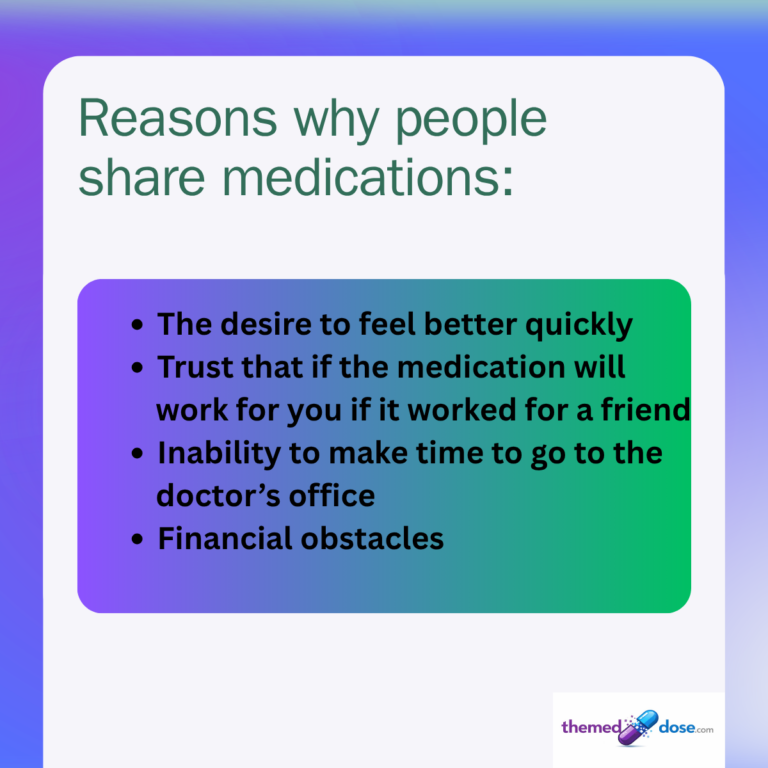
It is vital not to judge others who share medications or be too hard on yourself if you are one of them. Many of the factors are not under the patient’s control, but many are driven by the desire to act on illness treatment.
why do people share medication?
One of the largest factors stated above was the cost of office visits and medication. Many patients cannot afford healthcare and prescriptions, even with insurance. Some patients must see various specialists for different kinds of illnesses, which may not be manageable given the cost of healthcare. An example of this would be in the treatment of cardiovascular disease (CVD), where risk factors account for 15% of national health care spending and put a financial burden on patients and their support. It is estimated that about 1 in 8 patients suffering from CVD do not take the medication prescribed because of high out-of-pocket costs for both the doctor’s office appointment and the prescriptions (Nasir et al., 2023). Additionally, if the patient is still working, this time must be taken off work, leading to a lower paycheck.
Another factor is unawareness of the dangers of sharing medications. While working in retail, I have had patients wrongly assume that because a doctor wrote a prescription, the medication is safe for everyone. I can understand where this misconception can come from; however, even if something is “FDA approved”, it does not automatically mean safe for everyone.
Self-medication is not a concept that should be taken lightly. Self-medication should only involve appropriate over-the-counter medications used for the correct condition and for the recommended duration. Common self-medication errors occur on the customer side and include:
- Incorrect indication
- Harmful interactions
- Medication duplications
Pharmacists play an important role in the safety of medication self-care (Hayrinen et al., 2026). More will be detailed later in this article.
You can also read more about self-medication here.
why sharing prescription medcation is dangerous
Prescription Medications Affect Everyone Differently
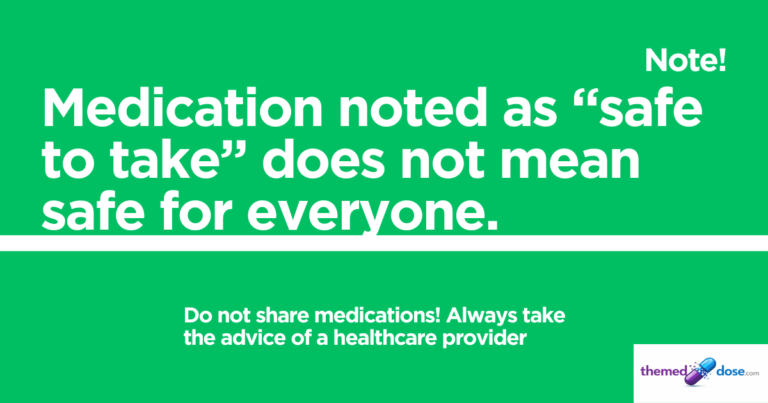
As noted above, a medication that is noted as “safe” does not mean that it is safe for everyone at every moment. Everyone’s body is unique, and how some people react to a medication may not be the same as others. During clinical trials, various factors are tested, and some factors are found to be dangerous for certain drugs. For example, a medication may be safe for a patient who was prescribed it, but their friend that they are about to share with may have an allergy to one of the ingredients.
Different Diagnoses Need Different Dosages and Frequencies
Many conditions could be treated with the same medication as another. There may also be instances where the same condition is treated with a different medication altogether, at a different dosage, and/or at a different frequency. An example would be diabetes; every patient has their own tailored treatment. If the patient is instructed to use a sliding scale method, their blood glucose is measured at times throughout the day, and they would take insulin if the blood glucose were too high (Lam et al., 2022). It is dangerous and could even be lethal for someone to offer their insulin to a friend or family member with the instructions they were specifically given. The individual who takes it from the patient could experience potential dangers, such as severe hypoglycemia. The medication, dosage, and frequency for one patient vary vastly on factors such as their age, genetic makeup, the severity of their disorder, and other conditions they may have. Taking a new drug without the advice of a physician is not advisable.
risk of Potential Drug Interactions
One of the roles physicians and pharmacists play is to review what other medications the patient is on to avoid any harmful drug interactions. When medications are shared internally by friends and family, this safeguard is completely removed. Drug interactions can range from mild side effects to severe, life-threatening complications.
It will Mask the True Issue
This could be one of the most impactful danger factors of all. This could lead to a major delay in treatment, making the illness worse. This includes taking the wrong antibiotic with self-medicating, allowing the bacteria to grow rapidly. This could lead to overall problems such as antibiotic resistance, further illnesses, and an inability to do daily tasks effectively while feeling sick. It is also important not to share narcotics. Masking the pain does not mean that the condition is cured; it is simply hiding the symptom. In many cases, pain is caused by an underlying problem, and it is a significant task to solve the problem. This also applies to depression and anxiety medication. Attempting to mask anxiety is very risky and could lead to a breakthrough attack if not treated properly.
Role of the Healthcare Team
Every member involved in patient care should take some responsibility in preventing the sharing of medications. While physicians should be more understanding when providing visit availability and offering an alternative when a medication is not covered by insurance, the pharmacist is usually the most available professional for many patients. When pharmacists provide patient education, it could reduce the risk of adverse effects and improve the therapeutic outcome. The pharmacist has specialized knowledge of all the medications that the patient is taking and understands their role in explaining the regimen to the patient (Omer et al., 2025).
I noticed in my time as a pharmacy technician that patients tend to have “muscle memory” when going through the prompts at the check-out register; however, one of the prompts asks if they have any questions for the pharmacist. I always ensure that the patient truly does not have a question and try my best to emphasize that the pharmacist will answer any questions openly with their expertise. Pharmacists and pharmacy technicians can help mitigate the unsupervised sharing of medications.
Conclusion
Sharing medications and accepting medications from others comes from good intentions, but may have harmful consequences. However, a medication that may have helped a friend may not be appropriate for others. Prescription medication is written for a person’s condition at the exact time, with their personal factors taken into consideration. If anyone ever has questions about medication safety, or is experiencing hardship getting their medication, they should speak to a physician or pharmacist as soon as possible, instead of sharing medication.
References
Hayrinen, A., Alastalo, N., Holmstrom, A. R., Siitonen, P., & Hameen-Anttila, K. (2026). Self-medication errors in community pharmacies. Res Social Adm Pharm, 22(5), 676-684. https://doi.org/10.1016/j.sapharm.2026.02.008
Lam, K., Gan, S., Nguyen, B., Jing, B., & Lee, S. J. (2022). Sliding scale insulin use in a national cohort study of nursing home residents with type 2 diabetes. J Am Geriatr Soc, 70(7), 2008-2018. https://doi.org/10.1111/jgs.17771
Nasir, K., Salami, J. A., & Mossialos, E. (2023). Prescription for Affordable Health Care: Promise and Perils of Inflation Reduction Act Tackling Financial Toxicity. J Am Coll Cardiol, 81(15), 1502-1504. https://doi.org/10.1016/j.jacc.2023.02.028
Omer, A. A. A., Kusuma, I. Y., Csupor, D., & Doro, P. (2025). Outcomes of pharmacist-led patient education on oral anticoagulant therapy: A scoping review. Res Social Adm Pharm, 21(6), 463-479. https://doi.org/10.1016/j.sapharm.2025.02.009